
Breaking Departure Cues: How to Stop Your Dog Panicking Before You Leave
Does your dog start panicking the moment you pick up your keys or put on your shoes? Learn why departure cues trigger anxiety and how to break these patterns with simple, effective desensitization exercises.
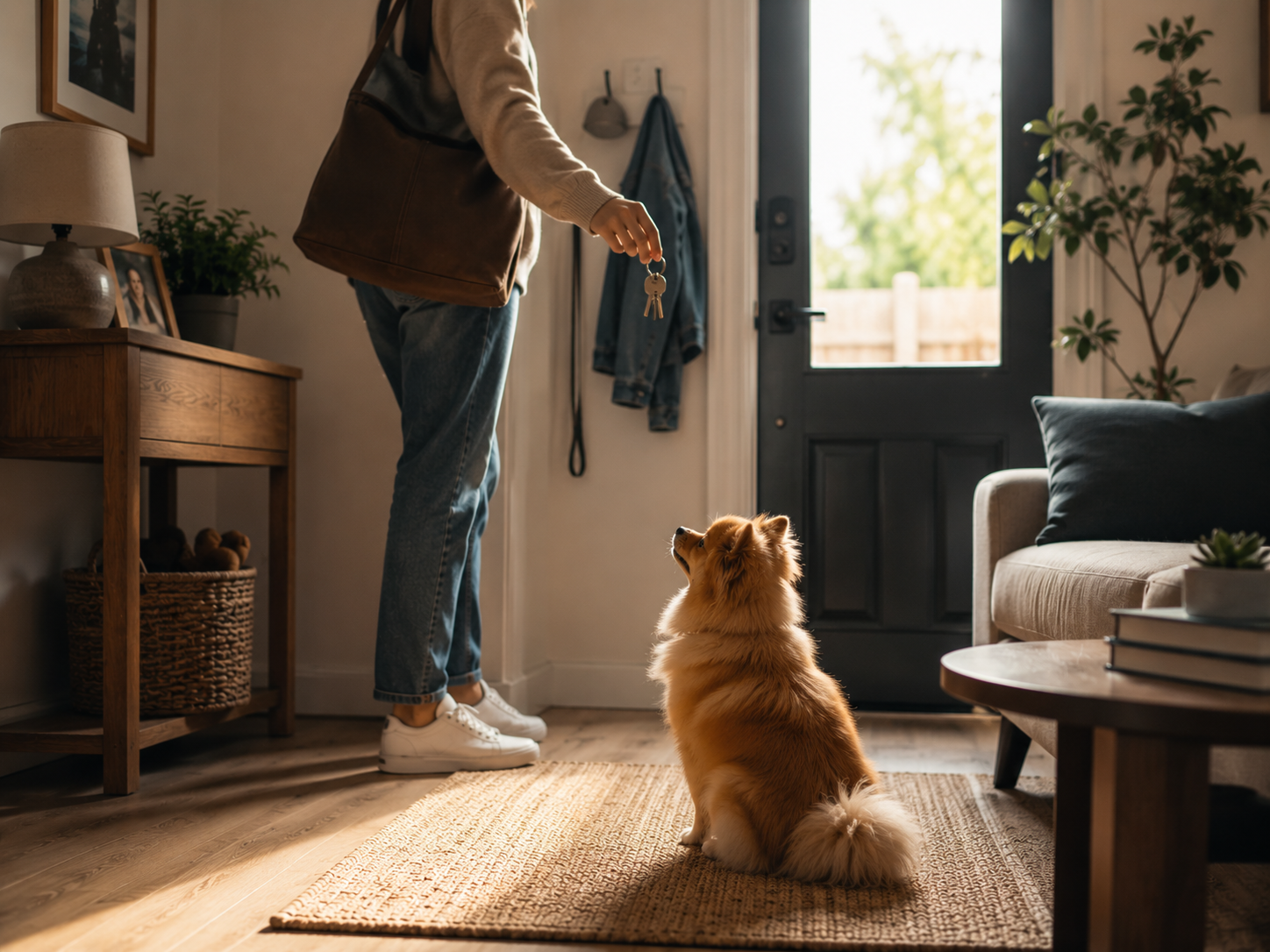
For many dog owners dealing with separation anxiety, the distress does not begin when they leave the house. It begins much earlier, often triggered by small, seemingly insignificant actions such as picking up keys, putting on shoes, or reaching for a jacket. These signals, known as departure cues, become powerful predictors of absence, and dogs quickly learn to associate them with being left alone. Over time, these cues can trigger anxiety before the owner has even approached the door, making the entire process more intense and difficult to manage. Understanding pre-departure anxiety is essential because it reveals that the problem is not just about being alone, but about anticipation and emotional buildup. By learning how these patterns develop and how to gently break them, owners can reduce stress, improve training outcomes, and create a calmer environment for both themselves and their dogs. This article explores why dogs react so strongly to departure cues and provides practical, realistic exercises to help desensitize those triggers over time.
Why Your Dog Starts Panicking Before You Even Leave
One of the most confusing experiences for dog owners is realizing that their dog becomes anxious before anything has actually happened. You haven’t left yet. You haven’t closed the door. You may not even be ready to go. And yet, your dog is already watching you, following you, becoming alert, or showing clear signs of stress.
This moment is often the first clue that separation anxiety is not only about absence, but about anticipation. Dogs are highly observant animals. They learn patterns quickly, especially when those patterns are repeated consistently in daily routines. Over time, what seems like a simple sequence to you—putting on shoes, picking up keys, grabbing your bag—becomes a predictable chain of events that always ends the same way. You leave, and they are left behind.
For a dog that struggles with being alone, this pattern becomes emotionally loaded. Each small action becomes a signal. Not just a neutral signal, but a warning. Something uncomfortable is about to happen. The emotional response starts earlier and earlier in the sequence, until eventually, even the smallest cue can trigger anxiety.
This is why some dogs react strongly to very specific objects. The sound of keys, the movement toward the door, the act of putting on a jacket—these are not random triggers. They are learned predictors. And once a dog has made that association, it can be surprisingly strong.
Understanding this changes how we approach the problem. If anxiety begins before you leave, then addressing only the moment of departure is not enough. The process leading up to it matters just as much.
What Are Departure Cues?
Departure cues are any signals that reliably predict that you are about to leave the house. They can be obvious or subtle, and they vary from one household to another.
Common examples include picking up keys, putting on shoes, wearing a jacket, grabbing a bag, turning off lights, or walking toward the door. But cues can also be less obvious. Checking your phone in a certain way, going to a specific room, or even changes in your body language can become part of the pattern.
Dogs do not need language to understand routines. They learn through repetition and association. If a sequence of actions consistently leads to a specific outcome, they will begin to anticipate that outcome as soon as the sequence starts.
This is a normal learning process. In fact, it is the same mechanism that allows dogs to learn commands, routines, and expectations in everyday life. The difference is that in the case of separation anxiety, the learned association is linked to something stressful.
Over time, the emotional response becomes attached not just to the absence itself, but to everything that predicts it. This is why some dogs start showing signs of anxiety minutes before their owner leaves. They are not reacting to the present moment. They are reacting to what they expect to happen next.
Why Pre-Departure Anxiety Makes Everything Harder
Pre-departure anxiety is important because it increases the overall level of stress the dog experiences. Instead of starting from a calm state and reacting only to being alone, the dog is already activated before the departure even happens.
This has several consequences. First, it makes the reaction to being alone more intense. The dog is not starting from zero. They are starting from an elevated emotional state, which means they reach higher levels of distress more quickly.
Second, it reduces the effectiveness of training. Many training approaches rely on gradual exposure and controlled conditions. If the dog is already anxious before the training begins, it becomes much harder to keep the experience within a manageable range.
Third, it affects the owner. Watching your dog become anxious before you leave is emotionally difficult. It creates pressure, increases guilt, and can lead to rushed or inconsistent departures. Over time, this can reinforce the cycle, because the departure itself becomes less predictable and more emotionally charged.
Breaking this cycle requires addressing the cues themselves, not just the absence.
The Psychology Behind Departure Cues
To understand how to change this behavior, it helps to understand the underlying mechanism. Departure cues are a form of classical conditioning. This is the same type of learning that explains why a dog salivates when they hear a food bowl or becomes excited when they hear a leash.
In this case, however, the association is negative. Instead of predicting something pleasant, the cue predicts something stressful. Over repeated experiences, the cue alone becomes enough to trigger an emotional response.
This is why simply ignoring the behavior rarely works. The association has already been formed. The dog is not choosing to react. They are responding automatically to a learned pattern.
The good news is that this type of learning can be changed. Associations can be weakened, reshaped, and replaced. But it requires consistency, patience, and a clear understanding of the process.
Practical Exercises to Break Departure Cues
The goal of desensitization is to reduce the emotional response to the cues by changing their meaning. Instead of predicting absence, the cues become neutral or even irrelevant.
Step 1: Identify Your Dog’s Triggers
Start by observing which actions trigger a reaction. This may include obvious cues like keys and shoes, but also more subtle patterns. Pay attention to when your dog becomes alert, follows you, or shows signs of stress.
Step 2: Break the Pattern
Once you identify the cues, begin performing them without leaving. Pick up your keys and put them back down. Put on your shoes and sit on the couch. Wear your jacket while staying at home.
The goal is to disconnect the cue from the outcome. When the sequence no longer reliably predicts departure, the emotional response begins to weaken.
Step 3: Repeat Without Pressure
Repetition is essential, but it must be calm and controlled. There is no need to rush. The goal is not to overwhelm the dog, but to gradually change their expectation.
Step 4: Mix Real and False Departures
As the dog becomes less reactive to the cues, begin introducing very short absences. Combine real departures with many “false” ones where you perform the routine but do not leave.
This creates unpredictability in a positive way. The dog learns that cues do not always lead to being left alone.
Step 5: Stay Consistent
Consistency matters more than intensity. Small, repeated exposures are more effective than occasional long sessions. Over time, the emotional response will begin to shift.
What Progress Actually Looks Like
One of the most important things to understand is that progress may be subtle. Your dog may not suddenly ignore the cues completely. Instead, you may notice small changes.
They may react more slowly. They may follow you less. They may settle more quickly after a cue. These changes are significant, even if they feel minor.
Progress is not the absence of reaction. It is a reduction in intensity, frequency, and duration.
Final Thoughts
Breaking departure cues is not about eliminating your routine. It is about changing what that routine means to your dog. By reducing the predictability of departure signals, you reduce the emotional buildup that leads to anxiety.
This process takes time, but it is one of the most effective ways to create a calmer starting point for separation training. When the dog is less anxious before you leave, everything that follows becomes easier to manage.
You are not just training your dog to be alone. You are teaching them that the signals of your daily life are safe, predictable, and not something to fear.
Log tonight's session from your phone
The Qualma app is available now on Android and iPhone. Sign in with your existing account — no need to subscribe twice.