
Dog Anxiety After a Routine Change: Why Alone Time Suddenly Gets Harder
Did your dog suddenly struggle with alone time after a routine change? Learn why small shifts in schedule can affect anxiety and how to adjust without losing progress.
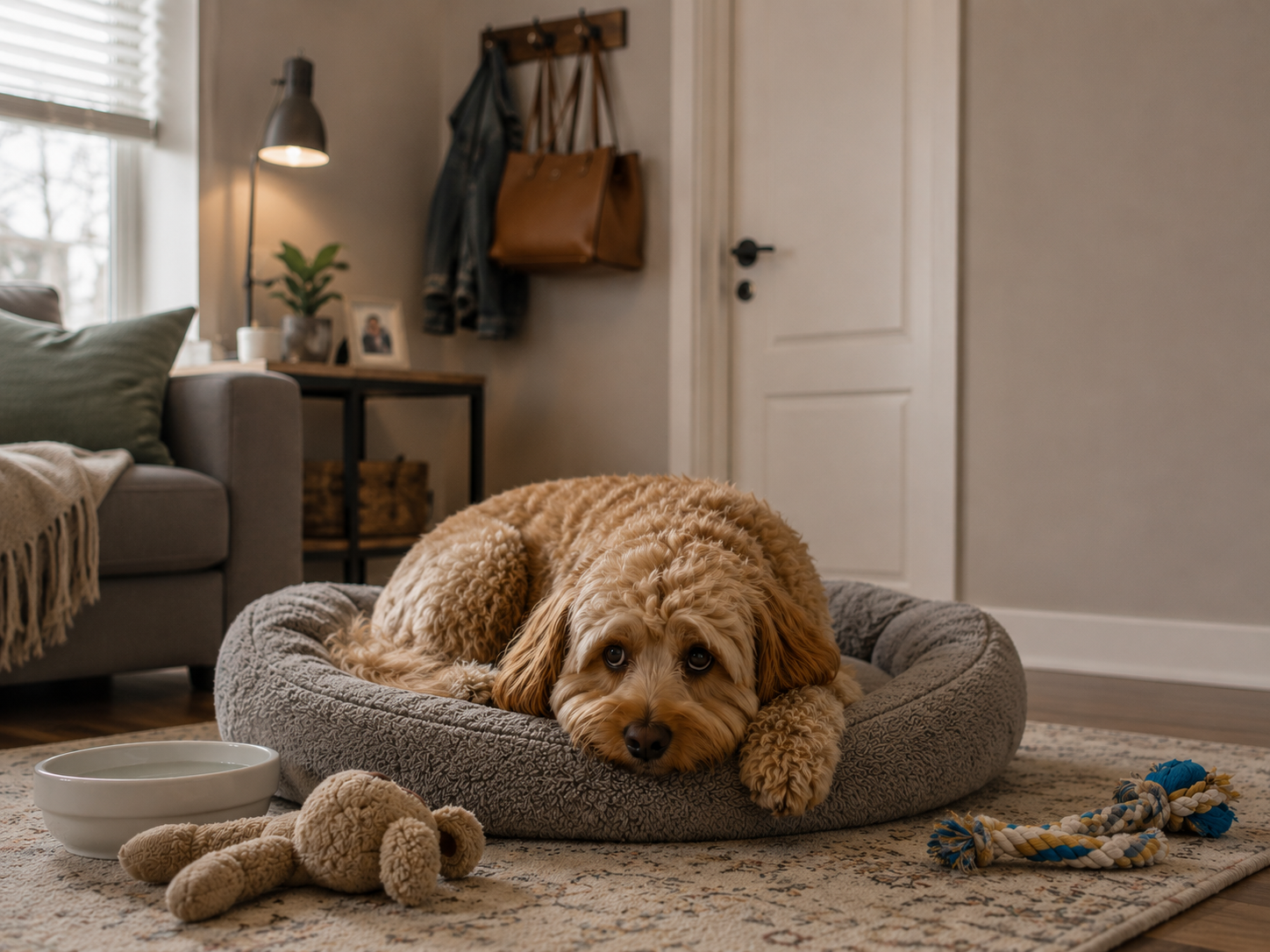
There is a very specific moment that catches a lot of people off guard, because it doesn’t look like a problem at first. Nothing dramatic has happened, nothing clearly “went wrong,” and yet your dog suddenly feels different. Alone time that was manageable becomes uncertain again, departures feel heavier, and the quiet confidence you were starting to trust begins to slip. Often, the only real change is your routine — going back to the office, guests leaving, a trip ending, or simply a shift in how your days unfold. What makes this difficult is that it doesn’t feel like a trigger, so it’s easy to miss. But for your dog, routine is not background noise — it is structure, predictability, and safety. When that structure changes, even slightly, their ability to cope can shift with it. And what looks like regression is often just your dog adjusting to a new version of the world.
When Life “Goes Back to Normal” — And Your Dog Doesn’t
One of the most confusing parts of separation anxiety is that problems often appear not when something intense happens, but when something ends. You come back from a holiday, your schedule changes, guests leave, or you return to work after being home for a while, and instead of things stabilizing, your dog becomes more sensitive.
From your perspective, life is returning to normal. From your dog’s perspective, the pattern they were just adapting to has disappeared.
Dogs don’t evaluate situations the way we do. They don’t label events as temporary or permanent. They learn sequences. They learn what tends to happen next. And when those sequences change, especially after a period of consistency, it creates a gap between expectation and reality.
That gap is where stress begins.
It’s not dramatic. It’s not loud. It’s a quiet increase in uncertainty. And uncertainty is one of the strongest drivers of anxiety.
Why Small Changes Feel Big to Your Dog
We tend to think of stress in terms of intensity. Loud noises, chaos, big disruptions. But for dogs, predictability often matters more than intensity.
A slightly different morning routine can matter. Leaving at a different time. Coming back at a different time. Eating later than usual. Walking earlier than expected. These are small shifts for you, but for your dog, they break the pattern they rely on to understand the day.
And when the pattern breaks, the question becomes: what happens next?
If your dog cannot answer that question through experience, their sensitivity increases. They start watching more closely, reacting earlier, and holding tension longer.
This is why alone time often becomes harder after routine changes. It is not just the absence that feels different. It is everything leading up to it.
The Accumulation You Don’t See
Routine changes rarely happen in isolation. They tend to come with other shifts layered on top.
Returning to the office often means longer absences and more rushed mornings. Guests leaving means a drop in stimulation after a period of constant activity. Travel means unfamiliar environments followed by another transition back home. Even a long weekend can mean less sleep, more noise, and a different rhythm.
Each of these adds a small amount of stress. None of them may seem significant on their own, but together they change your dog’s baseline.
And baseline is everything.
A dog that was coping well at a low stress level may struggle at a higher one, even if nothing else has changed. This is why the same duration that worked before suddenly feels too long.
It’s not that your dog forgot how to cope. It’s that they are coping with more.
When Alone Time Feels Different Again
What you often see after a routine change is not a complete breakdown, but a shift in timing.
Your dog may still handle being alone, but not for as long. They may react earlier. They may settle more slowly. They may show subtle signs of discomfort that were not there before.
This is where it becomes easy to misread the situation. Because technically, your dog is “still doing it,” just not as well.
But that difference matters.
It tells you that the threshold has moved.
And when the threshold moves, the strategy has to move with it.
The Moment People Overcorrect
When something starts to feel unstable, the instinct is to fix it quickly. That instinct is understandable, but it often leads to doing too much at once.
You might reduce alone time dramatically, or try to push through it, or change multiple parts of your routine at the same time. None of these approaches address the core issue, which is that your dog is adjusting to a new baseline.
Overcorrecting adds more change to an already unstable situation.
What your dog needs is not a new system. They need clarity within the current one.
Adjusting Without Losing Progress
The most effective response is often the simplest one, even if it doesn’t feel satisfying at first.
You go slightly below where your dog is comfortable now, not where they were comfortable before. You rebuild from there, calmly and without urgency.
You keep the structure of your day as consistent as possible, even if the schedule itself has changed. The order of events matters more than the exact timing.
You pay attention to how your dog settles, not just how long they stay alone.
And you give the system time to stabilize.
What usually happens, if you do this well, is that progress returns faster than expected. Because you are not rebuilding from zero. You are reconnecting with something that already exists.
Seeing the Pattern Instead of the Problem
The shift that makes the biggest difference is not in your training plan. It is in how you interpret what is happening.
If you see this as regression, it feels like loss. If you see it as adjustment, it becomes predictable.
Your dog is responding to change. That response has patterns. It has triggers. It has a timeline.
Once you start seeing those patterns, the situation becomes less emotional and more manageable. You stop reacting to each moment and start understanding the system.
And when you understand the system, you can support it instead of fighting it.
Why Catching It Early Changes Everything
The earlier you notice these shifts, the easier they are to correct.
Small changes in behavior are signals, not problems. Slight clinginess, faster reactions, shorter tolerance — these are early indicators that something has shifted.
If you adjust at this stage, the system stabilizes quickly.
If you ignore it and continue as before, the threshold drops further, and the adjustment becomes larger.
This is why awareness matters more than precision. You don’t need to get everything perfect. You need to notice when something feels different.
Final Thoughts
Routine changes are unavoidable. Life shifts, schedules evolve, environments change. None of that means you are doing something wrong.
What matters is how you respond when your dog shows you that something feels different.
You don’t need to fix everything. You don’t need to go back to the beginning. You need to recognize that your dog is adjusting, and adjust with them.
Because this is not a step backward.
It is your dog recalibrating to a new version of the same world.
And once that recalibration settles, progress continues — often more smoothly than before.
Log tonight's session from your phone
The Qualma app is available now on Android and iPhone. Sign in with your existing account — no need to subscribe twice.