
Why Do Dogs Develop Separation Anxiety? Understanding the Different Causes Behind the Same Behavior
Separation anxiety does not always have a single cause. Some dogs struggle from puppyhood, while others suddenly develop anxiety after a move, a traumatic experience, a change in routine, or simply as part of aging. Understanding the different pathways that can lead to separation anxiety helps owners make sense of behaviors that often seem confusing and unpredictable. This article explores the science behind separation anxiety, the most common risk factors, and why two dogs with similar symptoms
Introduction
One of the most frustrating moments for dog owners often comes after they have accepted that their dog has separation anxiety. The first shock is realizing there is a problem. The second shock is trying to understand why that problem exists in the first place.
Sometimes the answer seems obvious. A puppy has never learned to be alone and struggles from the beginning. A rescue dog arrives with an unknown history and shows signs of distress almost immediately. In these situations, owners can at least build a logical story around what they are observing.
What feels far more confusing is when separation anxiety appears suddenly in an adult dog. Many owners describe the same experience. Their dog spent years staying home alone without significant problems. Then something changes. The dog begins barking, pacing, following the owner more closely, or showing signs of distress that never existed before. The owner searches for explanations but cannot identify a single event that clearly caused the change.
The truth is that separation anxiety is not a single condition with a single cause. Modern behavioral science suggests that multiple pathways can lead to similar symptoms. Two dogs may both bark when left alone, yet the emotional and biological reasons behind that behavior can be completely different. Understanding these differences helps explain why there is no universal solution and why what works for one dog may fail entirely for another.
Separation Anxiety Is More Common Than Most People Realize
Research suggests that separation-related behaviors affect somewhere between 14% and 30% of pet dogs, making it one of the most common behavioral challenges seen by trainers, behaviorists, and veterinarians. Some studies have reported even higher numbers depending on the population being examined and the criteria used to define the condition.
What makes these numbers particularly interesting is that researchers have struggled to identify a single profile of a dog with separation anxiety. The condition appears in mixed breeds and purebred dogs. It affects males and females. It appears in puppies, adults, and senior dogs. It affects dogs living in apartments and dogs living in houses. It appears in dogs adopted from shelters and in dogs raised by the same family since puppyhood.
This diversity suggests that separation anxiety is not caused by one specific factor. Instead, it appears to emerge through a combination of genetics, life experiences, environmental changes, attachment patterns, learning history, and individual temperament.
Dogs Who Struggled From The Beginning
Some dogs appear predisposed to separation-related problems from an early age. Owners often describe these dogs as unusually attached, highly social, or exceptionally sensitive. From puppyhood, they show a strong preference for being near people and become distressed more quickly than other dogs when left alone.
Behavioral researchers believe genetics likely plays a role in these cases. Just as people differ in sensitivity, resilience, and emotional regulation, dogs appear to vary in these traits as well. Some dogs seem naturally capable of adapting to change and uncertainty, while others react more strongly to unfamiliar situations.
This does not mean that separation anxiety is entirely genetic. Rather, genetics may influence how vulnerable a dog is to developing anxiety under certain circumstances. Two puppies may experience similar environments, yet one develops separation anxiety while the other does not.
For owners, these cases can be particularly challenging because there is often no obvious mistake that caused the problem. The dog may have received excellent care, appropriate socialization, and consistent training. Despite that effort, the dog still struggles when left alone.
The Missing Practice Theory
One explanation that behaviorists frequently discuss involves learning history. During critical developmental periods, puppies gradually learn that temporary separation is normal and safe. Through repeated experiences, they discover that people leave and return without anything bad happening.
However, some dogs simply never have enough opportunities to learn this lesson.
The COVID-19 pandemic provided an interesting natural experiment. Millions of puppies spent their early lives surrounded by people almost constantly. Many owners worked from home, social activities decreased, and dogs became accustomed to near-continuous human presence. When normal routines eventually returned, some of these dogs struggled significantly with being left alone.
A similar pattern can occur for many other reasons. Owners may work remotely, take extended leave, experience major life changes, or simply spend most of their time with their dogs. While companionship itself is not harmful, the absence of opportunities to practice being alone can sometimes contribute to difficulties later.
Separation Anxiety Triggered By A Life Event
One of the most fascinating aspects of separation anxiety is that it can appear after a major life change.
Many owners can identify a specific moment after which everything seemed different. The family moved to a new home. A divorce occurred. Another pet passed away. A child left for university. A retirement changed daily routines. A period of illness increased the amount of time spent together.
Dogs thrive on predictability. They build expectations around routines, environments, and social relationships. When those patterns change suddenly, some dogs adapt quickly while others struggle.
Moving is one example frequently reported by owners. From a human perspective, the new apartment may simply be another place to live. From the dog's perspective, the environment has completely changed. Familiar smells disappear. Sounds are different. Walking routes change. The dog loses many of the environmental cues that previously signaled safety and predictability.
For sensitive dogs, these disruptions can sometimes contribute to separation-related problems.
The Trauma Hypothesis
Another pathway involves a negative experience that occurs while the dog is alone.
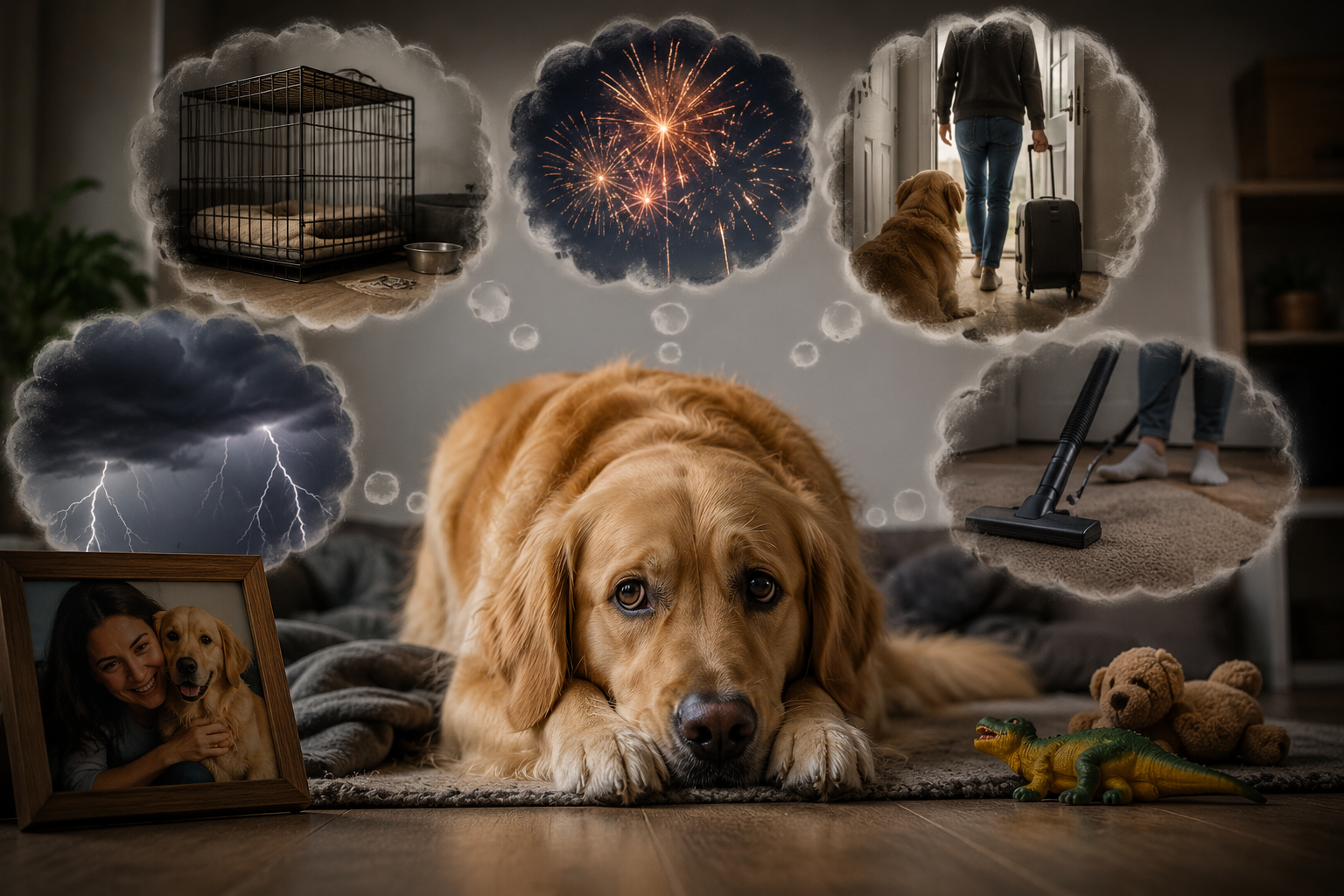
Behaviorists occasionally encounter dogs whose separation anxiety appears after a specific frightening event. Examples may include a severe thunderstorm, fireworks, a break-in, a medical emergency, construction noise, or another highly stressful experience that occurred during an absence.
The challenge is that owners are often unaware of what happened. They only observe the change in behavior afterward.
Imagine a dog experiencing a frightening event while alone at home. From the dog's perspective, something genuinely scary occurred during a period of isolation. The emotional brain may subsequently begin associating future absences with increased risk.
Not every dog develops anxiety after such experiences, but for some individuals these events may act as important triggers.
Senior Dogs And Late-Onset Separation Anxiety
Perhaps the most surprising category involves older dogs.
Many owners assume that if a dog reaches adulthood without separation anxiety, they are permanently protected. Unfortunately, this is not always true.
Veterinary behaviorists have observed that separation-related problems can emerge later in life, sometimes in dogs that previously tolerated being alone without difficulty. Several explanations may contribute to this phenomenon.
Cognitive aging is one possibility. As dogs grow older, changes occur within the brain that can influence confidence, adaptability, and emotional regulation. Dogs may become more dependent on familiar routines and familiar people.
Physical health can also play a role. Hearing loss, vision changes, chronic pain, or declining mobility may increase vulnerability to anxiety. A dog that once felt comfortable navigating the world independently may begin seeking additional reassurance from trusted humans.
From the owner's perspective, this change can feel particularly confusing because the dog may have spent many years behaving differently. Yet from the dog's perspective, their experience of the world may have changed dramatically.
Attachment And Personality Differences
Not all dogs form attachments in the same way.
Some dogs appear highly independent throughout their lives. They enjoy social interaction but are equally happy spending time alone. Others form exceptionally strong bonds with specific individuals.
Research into attachment behavior suggests that dogs share certain attachment characteristics with human children. They often use trusted humans as sources of security and reassurance. The strength and nature of that attachment can vary considerably between individuals.
Importantly, strong attachment does not automatically lead to separation anxiety. Many deeply bonded dogs remain perfectly comfortable when left alone. However, attachment style may influence how vulnerable certain dogs are when combined with other risk factors.
Why The Same Advice Doesn't Work For Every Dog
One of the biggest frustrations owners experience is conflicting advice.
A strategy that completely transformed one dog's behavior may produce little improvement in another. This inconsistency often leads people to believe they are doing something wrong.
In reality, the difference may simply reflect different root causes.
A dog whose anxiety emerged after a major life change may require a different approach than a dog with lifelong sensitivity. A senior dog experiencing cognitive changes may need different support than a young dog that never learned to be alone. A dog whose anxiety followed a traumatic event may require a different strategy than a dog whose challenge developed gradually over time.
The behaviors may look similar, but the underlying causes are not always the same.
If Separation Anxiety Appeared Suddenly, You Are Not Alone
Perhaps the most important message for owners is this: sudden separation anxiety is more common than many people realize.
Every week, behaviorists hear from owners asking the same question.
"What changed?"
Sometimes there is a clear answer. Sometimes there is not.
The absence of an obvious explanation does not mean the problem is imaginary. It does not mean the owner failed. It does not mean the dog is being difficult.
Dogs are living, emotional beings whose experiences are shaped by biology, environment, health, learning history, and countless small events that may never be fully visible to us.
Final Thoughts
One of the reasons separation anxiety feels so frustrating is that owners naturally want a clear explanation. We want a moment we can point to, a decision we can undo, or a mistake we can correct. Unfortunately, behavior rarely works that way.
Some dogs seem vulnerable from puppyhood. Others develop anxiety after moving, losing a companion, experiencing a frightening event, or entering old age. Some owners can identify a trigger immediately. Others spend years wondering what changed.
What matters most is recognizing that separation anxiety is not a reflection of failure. It is not proof that you spoiled your dog or made a catastrophic mistake. In many cases, it is the result of multiple factors interacting in ways that are impossible to fully predict.
If your dog's separation anxiety appeared suddenly, especially in adulthood, you are not alone. Many owners share the same confusion and frustration. Understanding the possible causes may not immediately solve the problem, but it often provides something equally valuable: the reassurance that what you are experiencing is real, common, and worthy of compassion for both the dog and the human trying to help them.
What To Do This Week
Write down what changed in the months before the behavior started, even if nothing seems obviously connected. A house move, a change in working hours, a new person in the home, an illness, a boarding stay, or another pet arriving or leaving are the usual candidates, and owners often only spot the link once it is on paper. If genuinely nothing changed, that is useful too, since it points toward missing practice rather than a triggering event.
Ask your veterinarian to rule out pain and illness before you settle on any explanation, particularly if the behavior appeared suddenly in an adult or older dog. Discomfort, cognitive decline and several treatable conditions can all produce distress that looks identical to separation anxiety from the outside. This is worth doing early rather than after months of training that was never going to address the real cause.
Then stop trying to identify the cause with certainty before you start helping. Many owners never find a definite answer, and waiting for one delays the work that helps regardless of origin: short absences your dog can cope with, built up gradually. The cause shapes the details of a plan rather than deciding whether the plan can begin.
Where the cause does matter is in what you expect. A dog who simply never learned to be alone often progresses steadily once taught, while a dog whose anxiety followed a frightening event may need a slower start and more support along the way. Knowing roughly which situation you are in helps you judge progress fairly, which matters more than most owners expect.
Log tonight's session from your phone
The Qualma app is available now on Android and iPhone. Sign in with your existing account — no need to subscribe twice.