
Why You Shouldn't Feel Guilty About Your Dog's Separation Anxiety
If you feel guilty every time you leave your dog alone, you're not alone. Separation anxiety affects not only dogs but also the emotional wellbeing of their owners. This article explains why guilt is such a common reaction, why it doesn’t actually help your dog improve, and how shifting your mindset toward progress and consistency can create better outcomes for both of you.
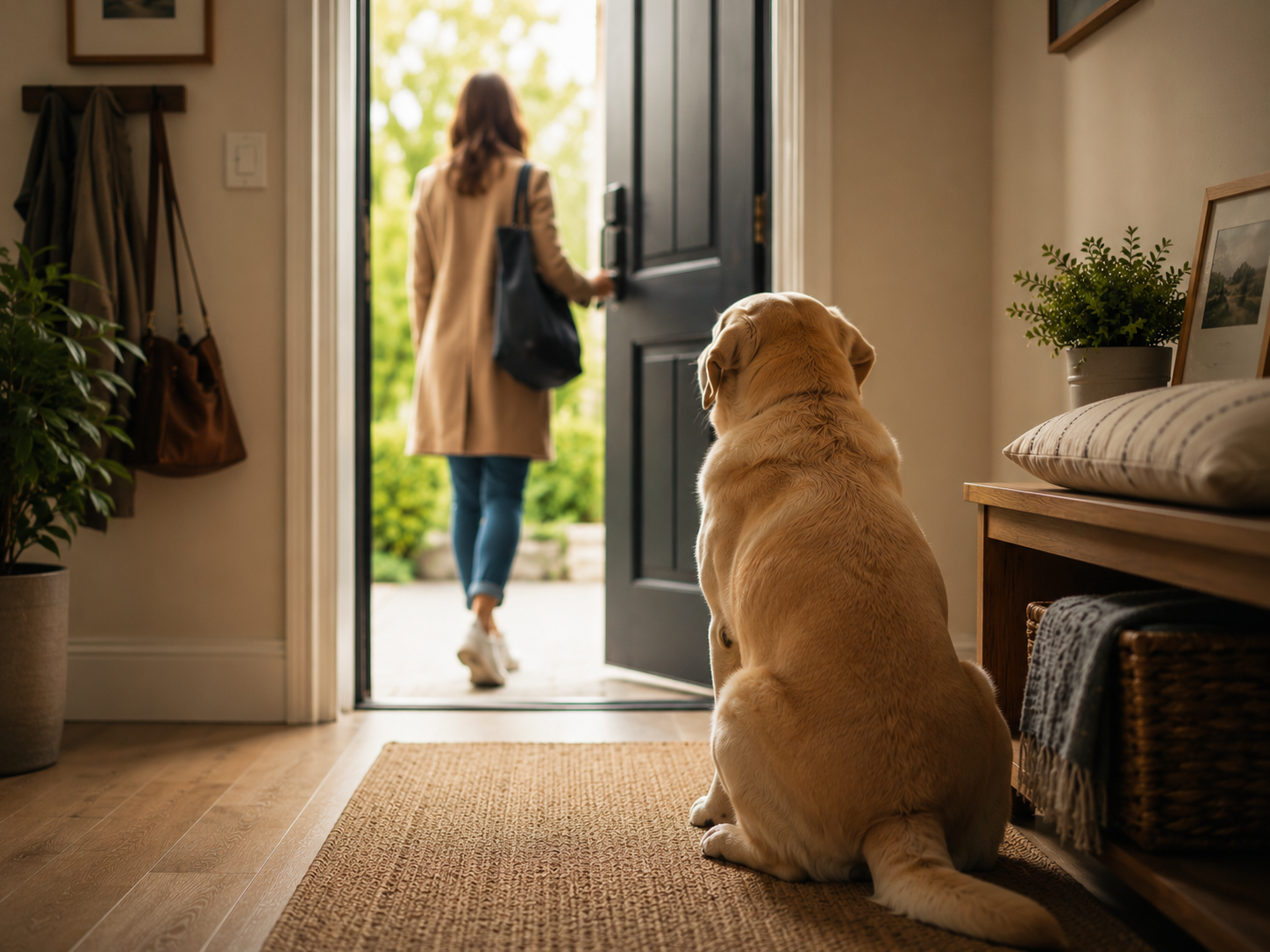
Living with a dog who struggles with separation anxiety is not only a behavioral challenge—it is an emotional one that deeply affects the owner’s sense of responsibility, freedom, and self-worth. While most educational content focuses on the dog’s symptoms and training protocols, far less attention is given to the internal experience of the person trying to help. Many owners carry a persistent sense of guilt every time they leave the house, hear their dog vocalize, or experience a setback in training. This guilt often feels justified, as if it reflects care and accountability, but in reality it frequently becomes a silent barrier to progress. Understanding why guilt appears, why it intensifies over time, and why it does not help your dog is essential for both emotional resilience and effective training. By shifting the focus from perfection to progress, and from self-blame to informed action, owners can create a healthier environment for themselves and their dogs. Supporting the human side of separation anxiety is not optional—it is one of the most important parts of the solution.
When Loving Your Dog Starts Feeling Like You're Constantly Letting Them Down
There is a moment many dog owners experience, though few talk about it openly. It happens when you close the door behind you and pause for just a second longer than usual. You listen. Maybe you hear nothing. Maybe you hear whining, scratching, barking, or movement. And in that moment, something shifts inside you. What should be a normal, everyday action—leaving your home—starts to feel like a betrayal. Not a dramatic one, not something you would admit out loud, but a quiet, persistent feeling that you are doing something wrong.
Separation anxiety does not stay contained within the behavior of the dog. It expands into routines, decisions, relationships, and identity. Owners begin to calculate everything: how long they can be away, whether they should go at all, how to structure their day around training sessions, enrichment, and monitoring. Over time, spontaneity disappears. Life becomes organized around avoidance of distress, both for the dog and for the human. And underneath this constant management, guilt grows.
Unlike frustration, which tends to be situational, guilt becomes personal. It attaches itself to who you are rather than what is happening. Instead of thinking “this is a difficult phase,” many owners begin to think “I caused this.” They revisit the past, searching for the moment where things went wrong. Was it the early socialization? The first time the dog was left alone? A move to a new apartment? A change in schedule? The adoption itself? The mind tries to simplify a complex behavioral condition into a single cause, because a single cause feels easier to understand and control.
But separation anxiety rarely develops from one decision. It is influenced by genetics, temperament, early experiences, attachment patterns, environmental changes, and learning history. Some dogs are simply more sensitive to separation. Some have a lower threshold for stress. Some have experienced disruptions early in life that shaped how they perceive absence. Two dogs raised in similar environments can develop completely different responses to being alone. The idea that you could have perfectly controlled every variable is not only unrealistic—it places an impossible burden on you.
The most important thing to understand is that guilt does not come from failure. It comes from care. The more you care, the more you notice, and the more you notice, the easier it is to feel responsible. This is why the most dedicated owners often feel the worst. They are the ones analyzing camera footage late at night, researching training methods, questioning their decisions, and trying to do everything right. Their guilt is not evidence of doing something wrong. It is evidence of being deeply invested.
Why Guilt Feels So Convincing
Guilt is powerful because it feels logical. It presents itself as responsibility, as awareness, as accountability. It tells you that if you didn’t care, you wouldn’t feel this way. And in some situations, that is true. Guilt can be useful when it highlights actions that need to change. But in the context of separation anxiety, guilt often goes far beyond what is useful.
One reason guilt feels so convincing is the immediacy of the dog’s response. When a dog vocalizes, scratches, or shows signs of distress, the feedback is immediate and emotional. It is not abstract. It is not delayed. It feels like a direct reaction to your absence, which makes it easy to interpret as something you are actively causing in that moment. The human brain is wired to connect cause and effect quickly, especially when emotions are involved. If I leave and my dog cries, it must be because I left. And if it is because I left, then I am responsible.
This reasoning makes sense on the surface, but it ignores a crucial detail. The behavior you see is not caused by the act of leaving itself. It is caused by the dog’s emotional response to being alone, which is shaped by many factors over time. Your presence or absence is the trigger, not the root cause. The difference matters, because it changes how we interpret responsibility. You are part of the context, but you are not the sole cause.
Another reason guilt intensifies is comparison. In the age of social media, it is easy to believe that other dogs handle alone time effortlessly. You see images of calm dogs sleeping on sofas, videos of owners leaving the house without concern, and stories of dogs who can stay alone for hours without issue. What you do not see is the variability, the setbacks, the training process, or the dogs who struggle just like yours. When you compare your reality to an idealized version of someone else’s, guilt naturally increases.
There is also an internal standard many owners carry without realizing it. The belief that a “good owner” should be able to meet all of their dog’s needs, prevent distress, and create a stable environment. When separation anxiety appears, it feels like a violation of that standard. It challenges the identity of being responsible, capable, and caring. Instead of adjusting the expectation, many people turn inward and assume they have fallen short.
Why Guilt Doesn't Help Your Dog
It may feel uncomfortable to hear this, but it is important: your guilt does not help your dog recover from separation anxiety. In some cases, it can actually make the process more difficult.
When guilt becomes dominant, it often changes behavior in subtle ways. Owners may avoid training because they do not want to see their dog uncomfortable, even though gradual exposure is a key part of progress. They may shorten departures to the point where the dog never learns to tolerate slightly longer absences. They may abandon structured plans too quickly because any sign of stress feels like failure. Or they may overcompensate with constant attention, unintentionally reinforcing hyper-attachment.
None of these behaviors come from a lack of care. They come from emotional overload. The intention is to protect the dog, but the result can be inconsistency, which slows down learning. Dogs benefit from predictability. They learn through repeated, manageable exposures that build confidence over time. When decisions are driven primarily by guilt, consistency becomes harder to maintain.
There is also an impact on your own mental state. Training a dog with separation anxiety requires patience, observation, and the ability to stay calm during uncertainty. If every session is filtered through self-blame, your stress level increases. You may start to doubt your decisions, second-guess your plan, or feel overwhelmed by small setbacks. Over time, this can lead to burnout, where the emotional cost of continuing feels too high.
Your dog does not need you to be perfect. Your dog needs you to be stable. A stable owner is someone who can follow a plan, adjust when necessary, and remain emotionally regulated enough to make decisions that support long-term progress. Reducing guilt is not about lowering standards. It is about creating the mental conditions that allow you to meet them.
Common Emotional Traps Owners Fall Into
One of the most difficult aspects of separation anxiety is that it creates patterns of thinking that feel accurate but are not necessarily helpful. These patterns can quietly shape decisions, reinforce guilt, and make progress feel slower than it actually is.
The first trap is personalization. This is the belief that your dog’s anxiety is a direct reflection of your actions or your relationship. It sounds like, “My dog doesn’t feel safe because I did something wrong,” or “If I were a better owner, this wouldn’t be happening.” Personalization ignores the complexity of behavior and reduces it to a single cause. It creates a sense of control, but it also creates unnecessary pressure.
The second trap is perfectionism. Many owners believe that training should follow a linear path, where each step builds smoothly on the previous one. In reality, behavioral progress is rarely linear. There are improvements, plateaus, regressions, and unexpected reactions. When perfectionism is present, any deviation from the plan feels like failure rather than information. This increases frustration and reinforces guilt.
The third trap is comparison. Looking at other dogs, other owners, or even past versions of your own dog can create unrealistic expectations. “They can do it, so why can’t mine?” or “We used to be able to leave for longer, what happened?” These comparisons rarely account for differences in context, environment, or individual sensitivity. They create pressure without providing useful guidance.
The fourth trap is urgency. The feeling that this needs to be fixed quickly, that progress should happen faster, that life cannot remain restricted for long. Urgency can lead to pushing the dog beyond their current threshold, which often results in setbacks. It also increases stress for the owner, making the process feel more intense than it needs to be.
Recognizing these traps does not mean you will stop experiencing them immediately. But it creates awareness. And awareness is the first step toward changing how you respond.
Log tonight's session from your phone
The Qualma app is available now on Android and iPhone. Sign in with your existing account — no need to subscribe twice.