
My Dog Settles by the Door — But Is Still Monitoring Everything
Is your dog lying by the door when alone—but not truly relaxing? Learn the difference between calmness, monitoring, and shutdown in separation anxiety.
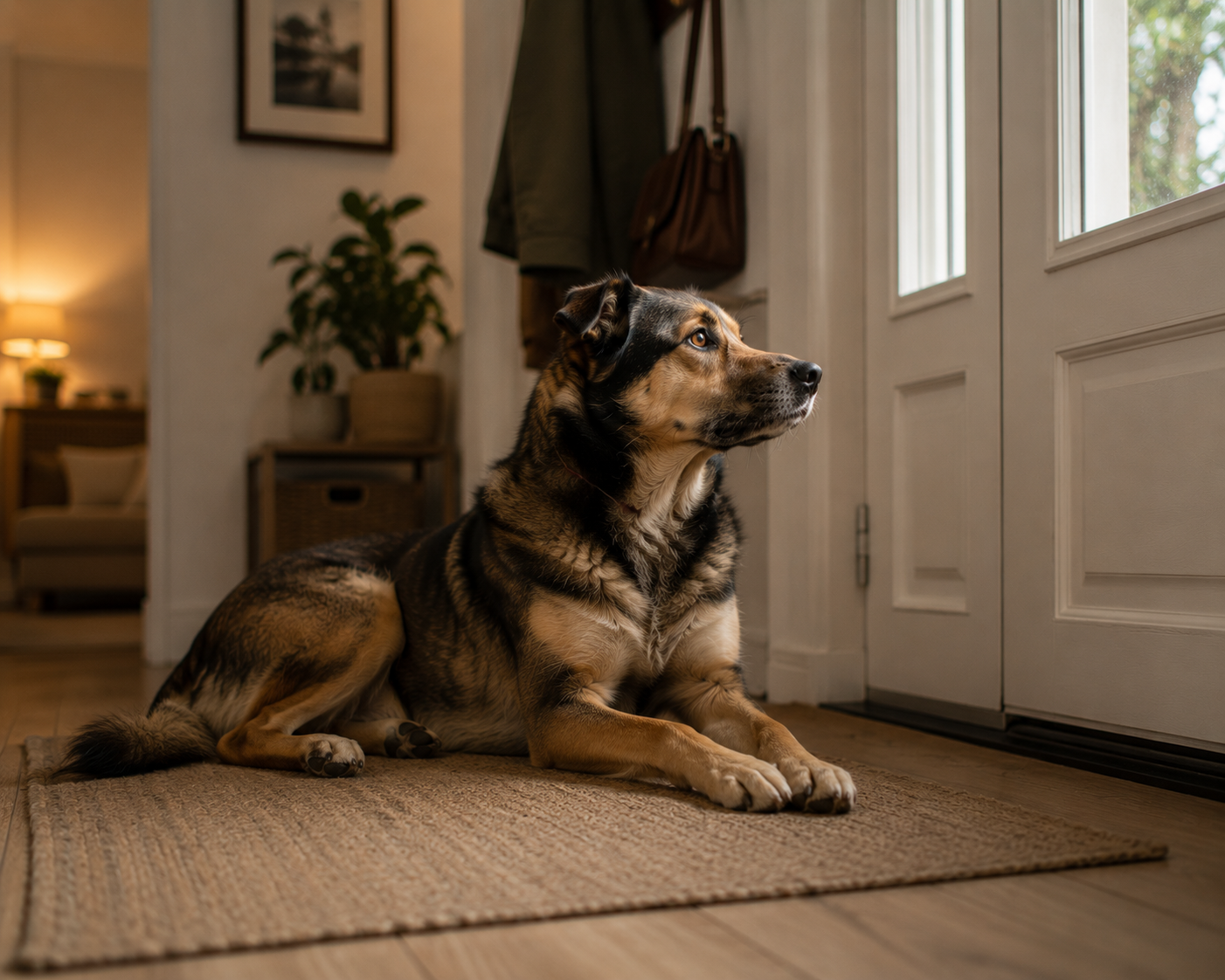
One of the most confusing patterns in separation anxiety is not obvious distress, but something quieter and harder to interpret: the dog lies down near the door, appears to settle, and yet never fully disengages from the environment. At first glance, this can look like progress, especially when compared to barking, pacing, or destructive behavior, but the details tell a different story. Some dogs rest near the door and genuinely relax, shifting posture, sleeping, and responding minimally to normal sounds, while others remain in a state of low-level vigilance, repeatedly scanning, reacting to hallway noise, and struggling to settle deeply. There is also a third pattern, less common but more concerning, where the dog becomes still not because they are calm, but because they are holding tension in a state closer to shutdown than relaxation. The difficulty is that all three can look similar from a distance, especially on short camera checks. Understanding the difference requires paying attention to movement, posture, reactivity, and recovery over time. When you shift from asking “is my dog lying down?” to “what state is my dog actually in?”, the behaviour becomes much clearer.
Why the Door Becomes the Center of the Dog’s World
The front door is not just a physical object for your dog.
It is a point of meaning.
It is where you leave, where you return, and where the outside world interacts with the inside environment. For a dog that is sensitive to separation or environmental noise, it becomes the most important location in the space.
This is why so many dogs position themselves near it when left alone.
From your perspective, it may look like a simple preference. From the dog’s perspective, it is the place where the most relevant information appears. If you are going to come back, it will be through that door. If something changes in the environment, it will often be detected there first.
So the behaviour itself—lying near the door—is not the issue.
The question is what the dog is doing while they are there.
When Resting by the Door Is Actually a Good Sign
There are cases where a dog settles near the door and is genuinely relaxed.
In these situations, the dog lies down with a loose posture, shifts position occasionally, and moves between light rest and deeper sleep. They may lift their head briefly when a sound occurs, but they do not remain engaged with it. After a short check, they return to resting.
Over time, they may move away from the door, or they may continue to use it as a resting place without it being the focus of their attention.
The key detail is that the door is not controlling their state.
It is simply where they happen to be.
This pattern reflects regulation. The dog is able to disengage from the environment even while positioned near a meaningful location.
When the Dog Is Not Resting — But Monitoring
The pattern becomes different when the dog remains focused on the door.
They may lie down, but their posture stays slightly elevated. The head lifts frequently, the ears respond to every small sound, and the body remains ready to move. Instead of transitioning into deeper rest, the dog stays in a state of light vigilance.
This is where you see repeated reactions to hallway noise.
Footsteps, doors closing, distant voices—each of these triggers a response. The dog gets up, moves toward the door, or shifts position, then returns to lying down, only to repeat the cycle again.
From a distance, this can still look like “settling.”
But the internal state is very different.
The dog is not relaxing.
They are waiting.
Why Monitoring Feels Stable — But Isn’t
Monitoring behaviour often feels like improvement because it is quieter than overt distress.
There is no barking, no pacing across the room, no destruction. The dog is contained, and the environment appears controlled.
But the stability is superficial.
The dog is holding attention on a single point rather than disengaging entirely. Their system is not escalating, but it is not recovering either. This creates a state that can be sustained for a while, but not indefinitely.
This is why dogs in this pattern may struggle to extend their alone-time tolerance.
They are not transitioning into rest. They are maintaining a controlled form of alertness.
And controlled alertness has limits.
When Stillness Is Not Calm, but Shutdown
There is a third pattern that is less obvious and often misunderstood.
The dog becomes very still.
They remain in one position for long periods, move minimally, and show little engagement with the environment. At first glance, this can look like calmness, especially if there is no vocalization or visible distress.
But the quality of the stillness is different.
The body remains tense. There is little natural shifting of position. The dog may refuse food, even high-value items. When you return, the reaction is disproportionate—intense movement, heightened excitement, or signs of accumulated stress.
This is not relaxation.
It is a form of shutdown.
The dog is not actively coping. They are reducing outward expression of stress while remaining internally activated.
Why These Differences Matter for Training
If you interpret all three patterns as “calm,” your next steps will be based on incomplete information.
You may increase duration because the dog appears stable. You may assume that tolerance is higher than it actually is. You may push forward into conditions that the dog cannot sustain.
This is where progress becomes inconsistent.
A dog that is resting can handle longer absences. A dog that is monitoring can handle only limited extensions. A dog that is shutting down may appear stable but react strongly once the threshold is crossed.
Understanding which pattern you are seeing determines how you move forward.
What the Camera Actually Shows
Without a camera, all of these patterns look the same.
You leave, you return, and you see a dog lying near the door. There is no visible evidence of what happened in between.
With a camera, the sequence becomes visible.
You see how often the dog shifts position, how frequently they react to sounds, whether they settle into sleep or remain alert, and how their state changes over time.
This is where interpretation becomes possible.
You are no longer guessing based on a single moment.
You are observing a process.
What to Look for Instead of Just Position
Position alone does not tell you enough.
You need to look at:
How long your dog stays in one posture, how often they lift their head, how quickly they respond to environmental sounds, and whether they return to rest afterward. You need to observe whether sleep occurs at all, and if it does, how deep and sustained it is.
You also need to notice what happens after you return.
A dog that was relaxed tends to remain regulated. A dog that was monitoring may show mild release. A dog that was in shutdown often shows a strong rebound in movement and emotion.
These patterns provide the context that position alone cannot.
Why Some Dogs Stay by the Door and Others Move Away
Over time, many dogs that are learning to cope with being alone begin to move away from the door.
This is not because they are being trained to do so, but because their reliance on that location decreases. As the environment becomes less uncertain, the need to monitor the point of entry reduces.
However, not all dogs follow this pattern in the same way.
Some dogs continue to rest near the door even when they are fully relaxed. For them, the location itself remains comfortable, but the emotional meaning attached to it has changed.
This is why movement away from the door is not the only indicator of progress.
The state of the dog matters more than the position.
Final Thoughts
A dog lying by the door is not a clear signal on its own.
It can mean calmness, vigilance, or shutdown, depending on how the dog is experiencing the environment. The difference is not in where the dog is, but in how they are processing what is happening around them.
When you start paying attention to state instead of position, the behaviour becomes easier to interpret.
And once you can interpret it correctly, your decisions become more accurate.
Because in separation anxiety, what looks calm is not always calm.
And what looks stable is not always sustainable.
Log tonight's session from your phone
The Qualma app is available now on Android and iPhone. Sign in with your existing account — no need to subscribe twice.