
Understanding Separation Anxiety: What Your Dog Is Actually Experiencing
Separation anxiety is one of the most misread behaviors in dogs. The barking, the chewed door frame, the puddle by the sofa — all of it looks like disobedience, and almost none of it is.
This page is about what is actually happening. What the condition is, what it looks like from the outside and from your dog's side of the door, why it develops, and how to tell it apart from the several other things that produce identical behavior.
What is separation anxiety in dogs?
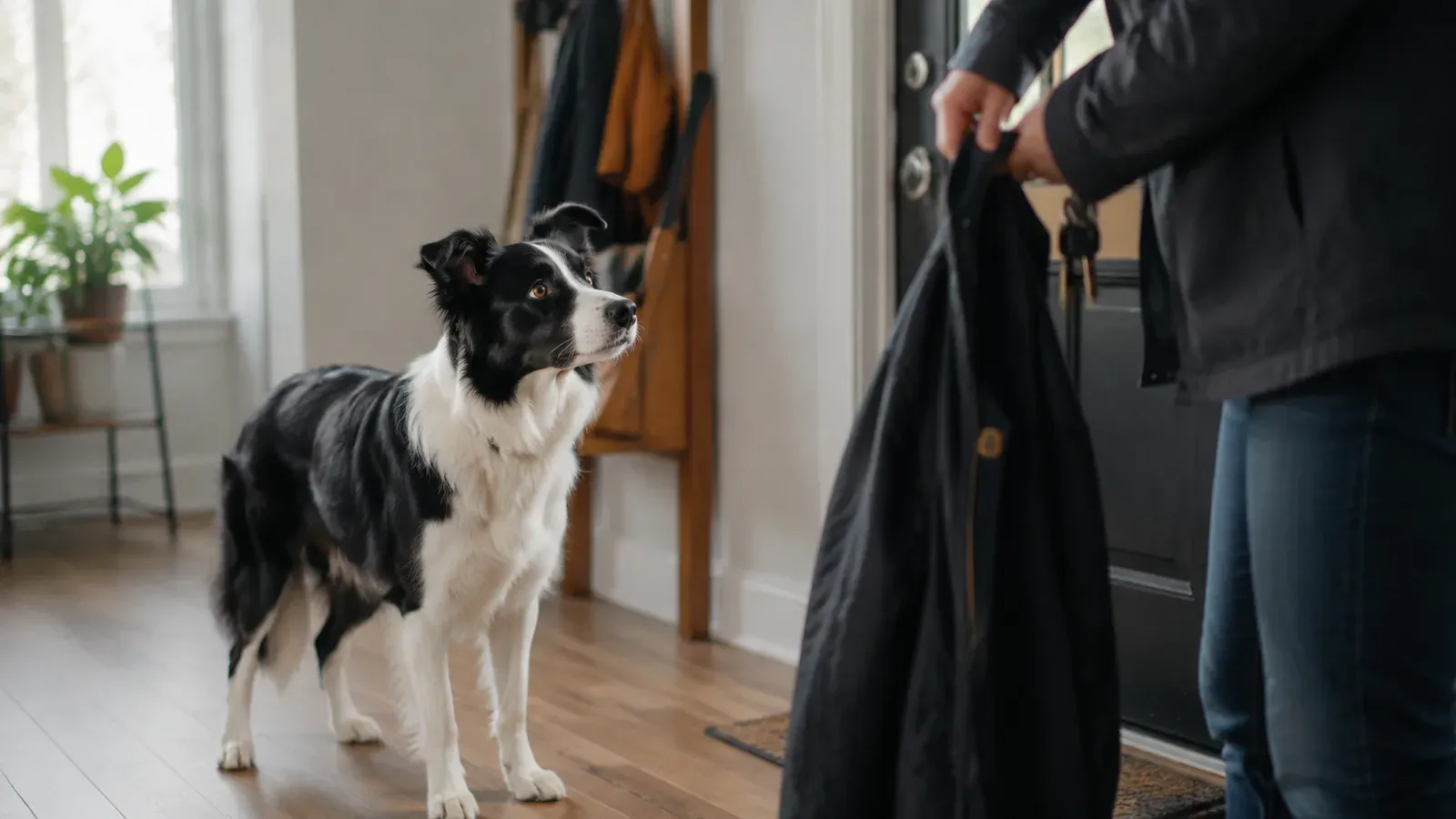
A dog with separation anxiety experiences genuine distress when separated from the person or people they are attached to. Not boredom, not frustration, not protest — distress, closer to panic than to disappointment.
The word 'anxiety' understates it for most owners. A more accurate comparison is being left somewhere unfamiliar with no way of knowing whether the people you depend on are coming back in five minutes or five hours, and no way to influence it. Dogs appear to experience something structurally similar.
It is also a spectrum rather than a condition you either have or do not. Some dogs are mildly unsettled and recover on their own; others cannot cope with the front door closing. Most sit somewhere between, and move along the scale depending on the day, the time and what happened beforehand.
What happens to a dog who cannot cope with being alone?
The nervous system responds as though something is wrong, because as far as the dog is concerned something is. Arousal rises, vigilance increases, and the body prepares for a threat it cannot locate or resolve.
That state has practical consequences that explain a great deal of what owners find confusing. A dog in it has limited capacity to eat, to settle, or to learn — which is why the expensive food toy goes untouched, why the dog will not lie down, and why 'practising' longer absences during real distress teaches nothing useful.
In Qualma: Record what your dog does in the first five minutes — that is usually where the answer is.
What are the signs of separation anxiety?
The obvious ones are vocalization, destruction near exits, and indoor toileting in a house-trained dog. Those are the signs that get noticed, because they make noise or leave evidence.
The more useful signs are quieter and happen earlier. Pacing, panting in a room that is not warm, drooling, an inability to settle, repeated returning to the door, and refusing food that would normally be taken instantly. These appear before the dramatic behaviors and they are what tells you where your dog's limit actually sits.
- Vocalizing. Barking, howling or whining that starts soon after you leave.
- Destruction at exit points. Doors, frames, windows — rather than random household items.
- Toileting indoors. In a dog who is otherwise reliably house-trained.
- Pacing and restlessness. Unable to settle anywhere for long.
- Panting or drooling. When the room is not warm and there has been no exercise.
- Refusing food. Not touching something they would take instantly if you were there.
What if your dog is completely quiet?
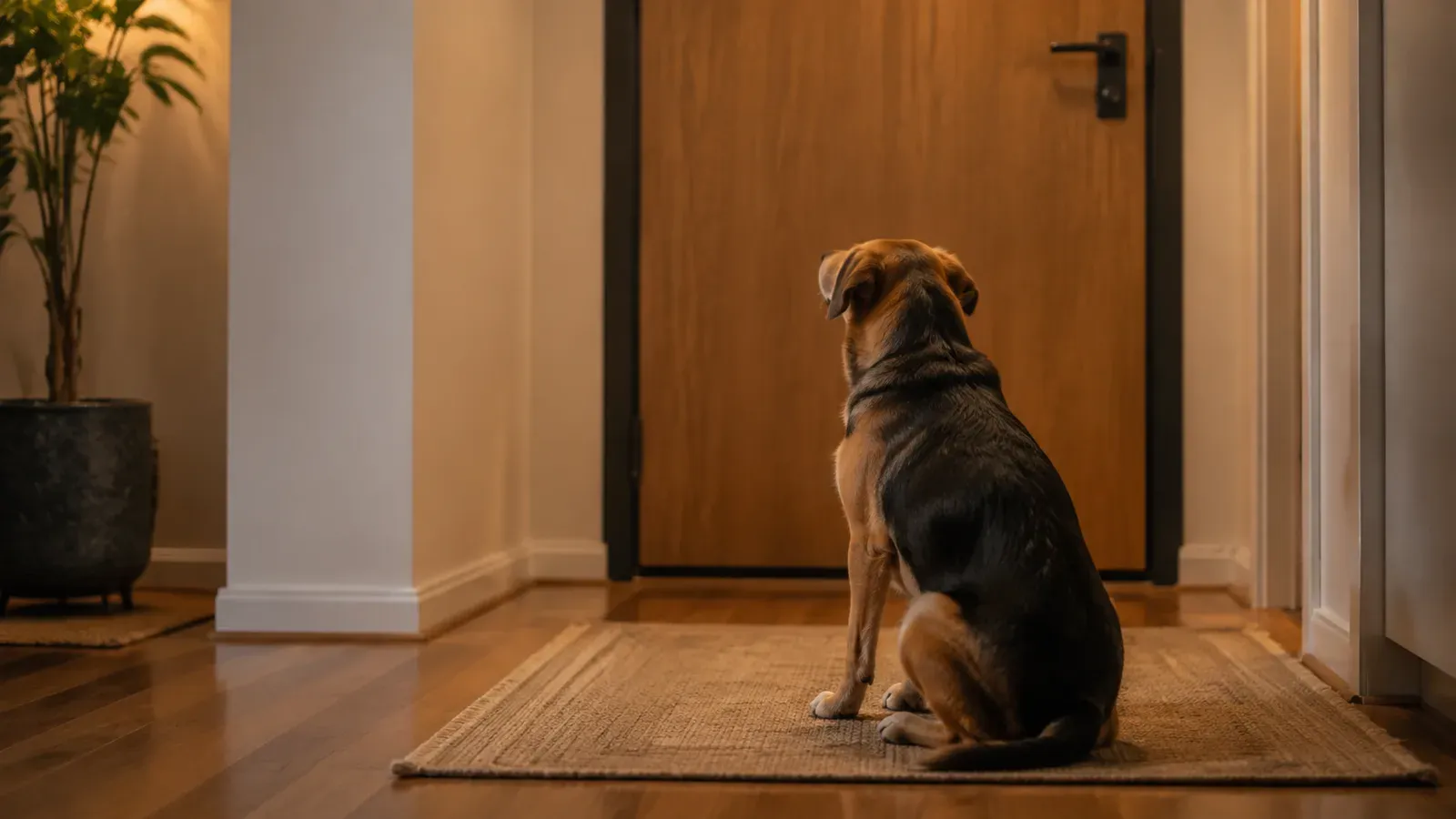
Then you may have the version that is hardest to spot. A dog who does not bark and destroys nothing can still be spending the entire absence in a held, vigilant state — not resting, not recovering, simply not making noise about it.
This matters because silence is the signal most owners use to decide things are fine, and it is the least reliable one available. A dog lying still by the door with their eyes open is not the same as a dog asleep on the sofa, even though a camera check at a glance shows both as 'calm'.
Is it separation anxiety or just boredom?
They produce similar-looking behavior and need completely different responses, so the distinction is worth getting right before you spend months on the wrong plan.
Boredom tends to be opportunistic and unhurried: the destruction is of interesting objects rather than exits, it can happen whether or not you are home, and the dog is otherwise relaxed. Anxiety is time-locked to your departure, concentrated near doors and windows, and accompanied by the physical signs above. A bored dog left with more to do usually improves quickly. An anxious dog left with more to do usually ignores it.
Is your dog doing it on purpose?
No. This is the single most common misreading of the behavior, and it is worth stating plainly because it changes what you do next.
A dog who destroys a cushion or urinates on the floor during an absence is not punishing you for leaving. Dogs do not construct that kind of plan, and the behaviors are what a distressed nervous system produces when it has no other outlet. Reading the damage as defiance leads logically to correction, which adds a second source of stress to a dog who is already overwhelmed — and reliably makes the underlying problem worse.
Why do dogs develop separation anxiety?
There is rarely one cause, and many owners never identify a definite trigger. The most common contributors are a dog who never learned to be alone in the first place, a change in routine that removed the practice they did have, a frightening event associated with being alone, or a health change that made everything harder to tolerate.
The honest position is that the cause shapes what to expect rather than whether you can help. A dog who simply lacked practice usually progresses steadily once taught. A dog whose anxiety followed a specific event may need a slower start. Neither needs a confirmed origin story before training can begin.
One exception is worth acting on. Separation anxiety that appears suddenly in an adult or older dog deserves a veterinary conversation before a training one, because pain, illness, sensory loss and cognitive decline all produce distress that looks identical from the outside.
Does following you everywhere mean your dog has it?
Not on its own. Plenty of dogs shadow their owners around the house and are perfectly comfortable when left, and plenty of dogs who are relaxed at home struggle badly with absences. The two are related but not the same thing.
What makes following worth noticing is when it comes with the other signals — an inability to settle unless you are in the room, distress when a door closes between you, or watchfulness that never quite switches off. Following alone is a preference. Following plus those is information.
How do you actually see what happens when you are gone?
You record it. Everything on this page is easier to judge from fifteen minutes of footage than from a fortnight of inference, and almost every owner who starts recording discovers their picture was wrong in some direction — usually more reassuring than reality, occasionally less.
It does not need to be a pet camera. A phone propped against a shelf works. What matters is watching the beginning rather than skimming for the dramatic part, because the first few minutes hold the signals that tell you where to start.
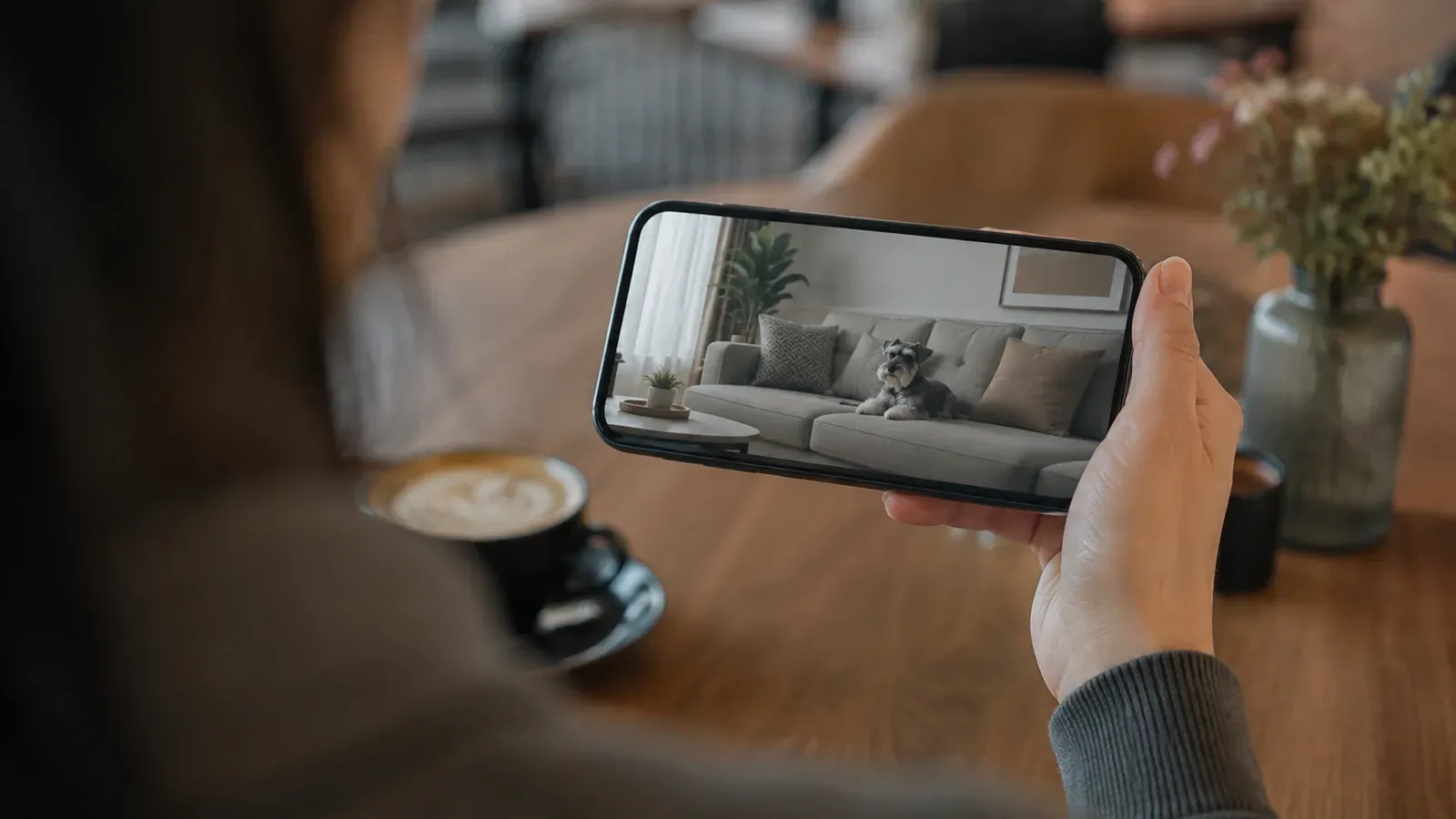
In Qualma: Log what you saw straight afterwards — the detail fades faster than you expect.
What do people get wrong about it?
Most of the persistent advice on this subject is either outdated or describes a different problem. Getting a second dog rarely helps and sometimes creates two problems. More exercise produces a tired anxious dog rather than a calm one. Ignoring the behavior does not extinguish it, because it was never being maintained by your attention in the first place.
The one worth naming explicitly: letting a distressed dog 'cry it out' does not teach them that being alone is safe. It gives them repeated practice at panicking, and it commonly makes the problem harder to solve rather than easier.
Read next
When should you involve a professional?
Sooner than most owners do. A veterinary conversation is worth having at the start rather than after months of training, particularly if the behavior appeared suddenly, if your dog is toileting indoors, or if anything about their general health has changed.
Beyond that, a qualified behavior professional is worth involving when the distress is severe, when your dog is at risk of injuring themselves or escaping, or when careful work over several weeks has produced nothing. None of those is a failure — they are the ordinary points at which a difficult problem benefits from someone looking at it directly.
How Qualma helps
See the pattern, not just today
Separation anxiety is hard to read precisely because it happens when you are not there, and what you can reconstruct afterwards is thin. One absence tells you very little; ten absences with their context tell you a great deal.
Qualma is where those observations accumulate. You record what you saw and what was happening around it, and over a few weeks the pattern becomes something you can look at rather than something you are trying to hold in your head.
- What you observed. Behaviors, the earliest signal, how long recovery took.
- The context around it. Time of day, what happened before you left, anything unusual.
- Your dog's own baseline. Compared against their history rather than another dog's.
- Trends over time. The Analysis view surfaces patterns across what you have recorded.
Understand your dog from what you have actually observed, not from what you can remember about last Tuesday.
Start recording what you seeCommon questions
- How do I know if my dog has separation anxiety?
- Record a short absence and watch the first five minutes. Distress that is time-locked to your departure, concentrated near doors, and accompanied by pacing, panting, drooling or refusing food points toward separation anxiety rather than boredom or a household accident. A formal assessment belongs with your veterinarian or a qualified behavior professional.
- Can a dog have separation anxiety without barking?
- Yes, and it is common enough to be one of the most missed presentations. Some dogs go still and vigilant rather than loud — no noise, no damage, and no rest either. Silence is the least reliable signal available for judging how an absence went.
- What causes sudden separation anxiety in dogs?
- A change in routine, a frightening experience associated with being alone, a house move, or a change in the household are the usual behavioral explanations. In an adult or older dog, a sudden onset also warrants a veterinary check, because pain, illness, sensory loss and cognitive decline can all produce distress that looks identical.
- Is my dog anxious or just bored?
- Boredom is unhurried and opportunistic, targets interesting objects rather than exits, and improves quickly when the dog is given more to do. Anxiety is tied to your departure, concentrated at doors and windows, comes with physical stress signs, and typically does not improve with enrichment alone.
- Will my dog grow out of it?
- Usually not without help. Separation anxiety tends to persist or worsen when nothing changes, because each difficult absence is more practice at being distressed. It responds well to structured work in many dogs, but waiting rarely resolves it on its own.
Log tonight's session from your phone
The Qualma app is available now on Android and iPhone. Sign in with your existing account — no need to subscribe twice.


Where to go next
Treatment & support
Veterinary assessment, professionals, cover and everything alongside training.
Train
Thresholds, gradual exposure, session structure and judging progress.
Start here
How Qualma approaches separation anxiety, and where to begin.
Enrichment
Food toys, licking, scent work, safety, and what enrichment can and cannot do.
Living with it
Guilt, a shrinking life, burnout, cost — and getting some freedom back.
All articles
Every guide on signs, causes, setbacks and living with an anxious dog.
Start with what you can actually see
Record one short absence, watch the beginning of it, and note what you find. Almost every useful decision from here rests on that.
Start with Qualma