
I Thought My Dog Was Calm Because Nothing Was Destroyed
Your dog is quiet when left alone—but not sleeping or relaxing? Learn the difference between calm behavior and silent separation anxiety, and how to interpret it correctly.
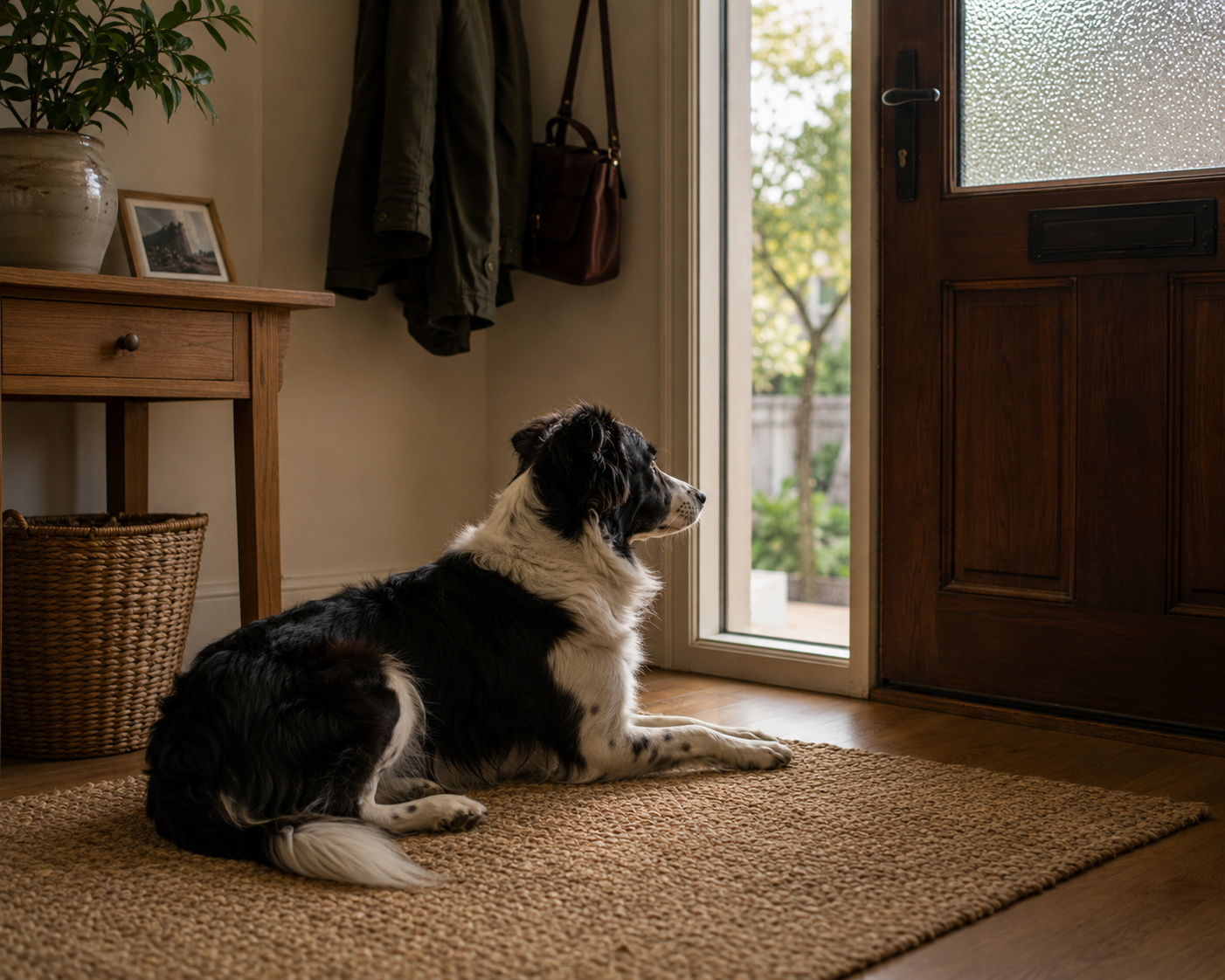
There is a very specific moment in separation anxiety work where relief turns into uncertainty, and it usually begins with something that looks like success. You leave your dog alone, you come back, and nothing is destroyed, nothing is out of place, and there is no obvious evidence of distress, which naturally leads to the conclusion that your dog is coping better than before. But when you begin to observe more closely, often through a camera, a different picture starts to form—one where the dog is not reacting, but also not relaxing. The absence of visible behaviour creates a false sense of stability, because it removes the signals you were previously using to measure stress, while leaving the internal state unchanged. What makes this pattern particularly difficult is that it does not feel like a problem; it feels like progress that does not quite hold. Understanding what is actually happening requires shifting from outcome-based thinking to state-based observation, where stillness is no longer automatically interpreted as calm. When you make that shift, you begin to see that silence can hide a form of stress that is quieter, but not less significant.
Why “Nothing Happened” Is So Easy to Trust
When you are dealing with separation anxiety, your baseline expectation is often disruption.
You expect barking, movement, signs that something is wrong. So when those things disappear, even temporarily, it creates a contrast that feels meaningful. The absence of visible problems becomes the signal you rely on.
This is where the interpretation begins to drift.
Because you are not evaluating what is happening. You are evaluating what is not happening. And what is missing becomes your evidence of progress.
That reasoning works where behavior directly reflects emotional state, which is true of plenty of problems but not reliably true of this one. Separation anxiety is not always expressed outwardly, and the expression can fade while the underlying state stays exactly where it was. When that happens, the absence of damage stops being evidence of progress and becomes actively misleading.
What Changes When You Start Watching the Full Absence
The moment you move from checking outcomes to observing sequences, the behaviour changes in meaning.
You stop looking at a single frame—your dog lying down—and start looking at what happens across time. How long they stay in one position, whether they shift naturally, whether they move between states, and whether those states include actual rest.
This is where the pattern becomes visible.
The dog lies near the door or another significant location, remains in a fixed position for extended periods, and shows very little variation in behaviour. They may not bark, they may not move, but they also do not engage, do not explore, and do not transition into deeper rest.
The absence becomes quiet without becoming resolved, and that distinction changes what you should do next. A quiet absence you misread as a settled one is the reason many owners extend duration at exactly the moment they should be holding steady.
Why Stillness Is Not the Same as Calm
Calmness has movement in it.
A calm dog does not stay frozen in one state. They shift, stretch, adjust their position, and move between light rest and deeper sleep. Their body softens over time, and their attention drifts away from the environment.
Stillness, in this context, is something else.
It is controlled, sustained, and often slightly tense. The dog holds a position instead of moving through it. Their body remains ready, even if they are not actively reacting. Their attention stays connected to the environment, rather than disengaging from it.
This is why a dog who sits still for the whole absence, or barely moves on the camera, is not making a neutral observation available to you. Stillness of that kind is a signal in its own right, and usually one that the system has not fully relaxed.
The Quiet Shift From Reactivity to Monitoring
When a dog stops reacting outwardly, the underlying stress has not necessarily gone anywhere. Sometimes what has changed is only the expression, which is a much smaller change than it appears from the other side of the door.
Instead of barking or pacing, the dog shifts into monitoring. They watch, listen, and remain ready. They track sounds, movements, and changes in the environment, even if they do not act on them immediately.
This is where you see a dog who holds one position until you return, or who is quiet throughout without ever actually sleeping. From the outside it looks stable, and on a camera it can look like success. Internally it is still an active state: your dog is not escalating, but they are not recovering either, and holding that middle position costs them something across an hour.
Why Some Dogs Freeze Instead of React
Not all dogs respond to stress with movement.
Some dogs reduce movement as a way to manage it. This is not a conscious strategy, but a physiological response that limits outward expression while maintaining internal activation.
This is what is often described as a freeze response.
The dog remains still, avoids drawing attention, and holds a state that allows them to tolerate the situation without resolving it. Over time, this can become the default pattern, especially in dogs that have learned that reacting does not change the outcome.
This is why a dog who freezes when you leave, or shows what gets described as silent separation anxiety, is so difficult to read. The absence of a reaction is not nothing happening — it is something else happening, in a form that produces no noise and no mess for you to find.
Why Food Becomes Irrelevant in This State
One of the clearest indicators of this pattern is the absence of engagement with food.
Even high-value items, which would normally attract attention, are ignored. Not because the dog is uninterested, but because their state does not support interaction.
Stress shifts priorities.
When the dog is monitoring the environment, food becomes secondary. The system is focused on assessing safety, not on exploration or reward.
This is why a dog who looks calm but will not eat when alone is giving you such a reliable signal. Refusing food they would take instantly in your presence shows the behavior is not being driven by preference at all, but by the state they are in.
Why This Pattern Creates False Progress
Because this behaviour is quiet, it is easy to misinterpret it as improvement.
You extend duration, assuming that the dog is comfortable. You increase expectations, because there are no visible signs of distress. And for a while, the pattern may hold.
But it holds under tension, and tension does not disappear simply because it is being controlled — it accumulates. Eventually the accumulation reaches a point where your dog can no longer maintain the same level of control, and the behavior shifts again, often into something more visible and more intense than anything you saw before.
That is where the confusion deepens, because the new behavior looks like a setback arriving out of nowhere. In fact nothing regressed. What looked like progress was never stable enough to build on, and the collapse is the first honest reading you have had in weeks.
Final Thoughts
The mistake is not believing your dog was calm, which is a reasonable conclusion from the evidence in front of you. It is treating silence as sufficient evidence, when silence is the one signal that can mean either recovery or its opposite.
A dog that is quiet but not sleeping is not in a resolved state. They are holding a position in a system that has not yet settled, maintaining control rather than releasing it. That difference is not immediately visible, but it becomes obvious over time, especially when expectations begin to exceed what the system can support.
This is why interpretation matters more than observation on its own. What you are building in separation anxiety is not the absence of a reaction, which a dog can achieve through suppression as easily as through calm. You are building the ability to let go of the vigilance entirely, and until that happens, silence will always be an incomplete answer.
Log tonight's session from your phone
The Qualma app is available now on Android and iPhone. Sign in with your existing account — no need to subscribe twice.