
Dog Separation Anxiety Treatment, Management and Support
Training is one part of helping a dog with separation anxiety. It is rarely the whole of it, and treating it as the whole of it is why a lot of owners work very hard for months and see very little.
This page covers everything that sits alongside the training: when to involve your veterinarian, what a medication conversation actually is, how to choose a behavior professional, how to cover the absences you cannot avoid, and which environmental changes are worth making.

Why does support usually have to be layered?
Because separation anxiety is rarely caused by one thing, and the pieces interact. A dog in pain will not respond well to training. A dog left alone for eight hours on Wednesdays will not consolidate what they learned on Tuesday. A dog whose owner is exhausted will not get consistent sessions.
The practical version of this is that you are usually assembling three separate things at once: the training itself, management that stops the situation getting worse while the training happens, and support from people qualified to assess what you cannot. Progress tends to come from the combination rather than from any one of them.
What is the difference between training, management and treatment?
Training changes what your dog can cope with. Management changes what your dog has to cope with. Treatment addresses something underlying that is making both harder.
The distinction matters because they are often confused, and a plan made of only one of them stalls. Arranging a dog walker is management: it does not teach your dog anything, but it stops the long absences that would undo the training. Doing short absences below threshold is training. A veterinary assessment that finds an untreated joint problem is treatment. Most successful plans use all three, and the mix changes over time.
- Training. Short absences your dog can handle, built up gradually.
- Management. Cover, environment, and routine — so uncontrolled absences stop.
- Treatment. Anything medical or professional that changes the underlying picture.
Where does your veterinarian fit in?
Earlier than most owners think. A veterinary conversation is worth having near the start rather than after months of training, because several medical situations produce distress that looks exactly like separation anxiety from the outside.
This is particularly true when the behavior appeared suddenly in an adult or older dog, when there is indoor toileting in a house-trained dog, when your dog's sleep or appetite has changed, or when anything else about their general health seems different. Pain, gastrointestinal problems, urinary conditions, sensory loss and cognitive decline can all present this way, and none of them respond to a training plan.
It is also simply useful to have your vet aware of the situation from the beginning. If the picture changes later, they have context rather than starting cold.

In Qualma: Take your recorded observations to the appointment — specifics get a more useful consultation than impressions.
What about medication?
It is a legitimate part of treatment for some dogs, and it is neither a shortcut nor a last resort. That framing — medication as either a quick fix or an admission that you have failed — causes a great deal of unnecessary delay, and the delay costs the dog.
Where medication is appropriate, what it does is reduce distress enough that a dog can actually learn from the training. A dog in panic has very limited capacity to take in new information; that is how the nervous system works rather than a lack of effort or willingness. Lowering the panic is what makes the training possible. It does not replace it, and on its own it generally does not resolve the problem.
Several categories of prescription medication are used in separation-related distress, and you will also encounter a wide range of over-the-counter supplements and calming products sold for the same purpose. Whether any of them is appropriate for your dog — and which — depends on their history, their health, anything else they are taking, and the severity of the problem. That is a conversation with your veterinarian, and it is not one this page can have for you. Naming a specific product, or suggesting how long anything should take, without knowing your dog would be worse than unhelpful.
What is worth preparing for that appointment is your own record: what you have seen, how often, how severe it gets, what you have already tried and what happened. Appointments are short, and an owner who arrives with observations rather than impressions gets considerably more out of them.
How do you choose a behavior professional?
Look first at what they do when a dog is struggling, because that is where approaches differ most. A professional working on separation anxiety should be building experiences your dog can cope with, not pushing your dog through distress to prove a point.
The single clearest filter is their position on aversive methods. Anyone recommending shock, prong or choke collars, physical corrections, or 'letting them cry it out' for a dog in genuine distress is describing a method that adds fear to a fear problem. That is worth walking away from regardless of credentials or confidence.
Beyond that, ask what qualification they hold and who accredits it, whether they work with your veterinarian when medical questions arise, and how they measure progress. A professional who cannot describe what improvement would look like in six weeks is worth questioning.

Who can cover the absences you cannot avoid?
Almost anyone your dog is comfortable with, and this matters more than it sounds. Long absences your dog cannot yet manage work directly against the short ones you are carefully building — so cover during the training period is not a luxury, it is often what makes the training possible at all.
A sitter, a walker, a family member, a neighbour, or a friend working from your flat for an afternoon all serve the same purpose. What matters is the timing rather than the arrangement: a visit that lands before your dog reaches real distress helps, while one that arrives afterwards simply divides a difficult absence into two.
- Time it against your dog, not the diary. Cover placed after distress begins does not prevent it.
- Keep the person consistent where you can. A familiar visitor asks less of an already-stretched dog.
- Treat it as temporary. Cover buys the conditions for training; it is not the plan itself.
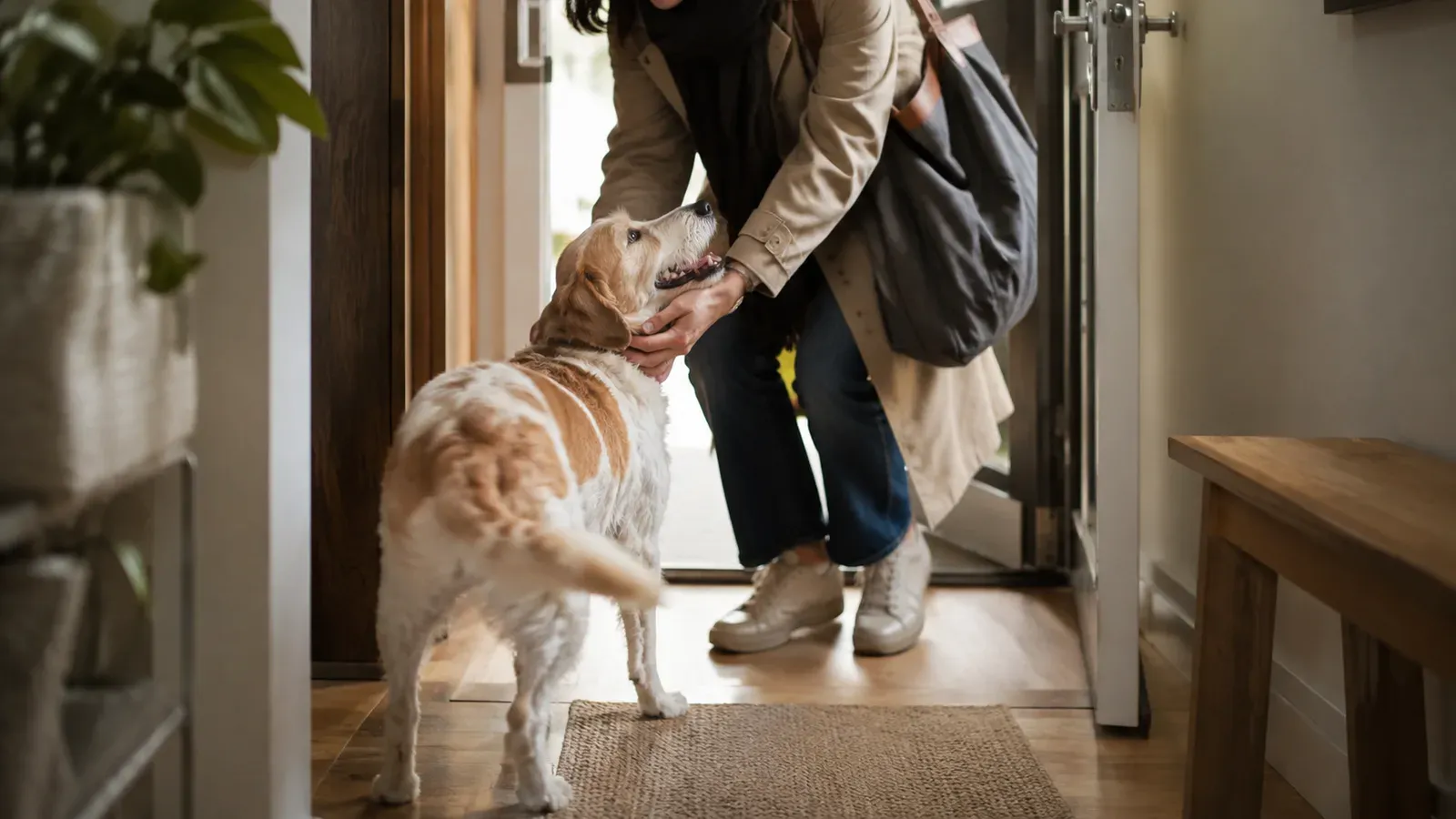
Is daycare a good idea?
It depends entirely on the dog, and the answer has less to do with separation anxiety than with how your dog feels about other dogs. A sociable dog can come home from daycare genuinely content. A dog who finds other dogs stressful can come home more depleted than they started, having spent the day coping rather than resting — even though they were never alone.
If you are unsure, one trial day tells you more than any amount of deliberation. Judge it by how your dog is that evening rather than by how they seemed at pickup, since excitement at collection is not the same as having had a good day.
What can you change about the environment?
Less than the internet suggests, but a few things genuinely help. Somewhere comfortable to settle that is not directly at the front door, curtains that reduce street activity if your dog reacts to what passes, and a room that does not amplify every sound in the building are all worth arranging.
What environment cannot do is substitute for training. A perfectly set-up room does not teach a dog that absence is survivable; it removes some of the things making it harder. That is worth having, and it is not the same as progress.

Does sound actually help?
For some dogs and some problems. Where a dog is reacting primarily to what they can hear outside — a busy street, a stairwell, building work — masking that noise can genuinely reduce the trigger. Where the distress is about being alone rather than about noise, sound tends to make very little difference.
The useful test is whether your dog's difficult moments line up with external sounds. If they do, masking is worth trying. If your dog reacts at the moment the door closes regardless of what is happening outside, sound is not the lever.
Are crates helpful or harmful?
Both, depending on the dog and on how the crate is being used. For a dog who already finds a crate a genuinely safe place, it can support settling. For a dog who does not, confining them during an absence they already cannot cope with adds restriction to panic — and that combination causes injuries.
The honest general position is that a crate is not a treatment for separation anxiety and should never be the default answer to it. If your dog is distressed and also confined, the distress has nowhere to go. Watch what your dog does when the crate door is open and they are free to choose.
How much do exercise, sleep and routine matter?
They matter as foundations rather than as treatments. A dog who is chronically under-slept, under-stimulated, or living with an unpredictable schedule has less capacity for everything, including coping with absences. Fixing those does not resolve separation anxiety, but leaving them broken makes everything else harder.
One caution worth stating: exercising a dog into exhaustion before leaving is not a strategy. A tired anxious dog is still an anxious dog, and building a plan around physical depletion tends to stop working exactly when you need it — on the day the walk was shorter.
What about travel and being away from home?
New places reset a lot of the context your dog has learned, so progress made at home does not automatically travel. A dog who copes with an hour alone in their own flat may cope with far less in a hotel room, and that is not a regression — it is a different situation.
Plan for the drop rather than being surprised by it. Shorter absences, more cover, and familiar bedding and items usually do more than trying to hold the line at whatever duration was working at home.
How do you put it together?
Start with the medical question, because it changes everything downstream and takes the longest to arrange. Then get the management in place — cover for the absences you cannot avoid — because without it the training cannot accumulate. Then train, consistently, at a level your dog can handle.
Add support as the picture tells you to, rather than all at once. Changing four things in the same fortnight leaves you unable to tell which of them mattered, which means you cannot repeat what worked or drop what did not.
- First. A veterinary conversation, particularly if anything appeared suddenly.
- Then. Cover, so uncontrolled long absences stop.
- Then. Consistent short sessions below threshold.
- As needed. A behavior professional, environment changes, and anything your vet recommends.
In Qualma: Record what changed and when, so an improvement can be traced back to something rather than guessed at.
How Qualma helps
Keep the thread when several things are changing at once
Support plans move. Medication conversations happen, cover arrangements change, a professional adjusts the approach, the routine shifts. Six weeks later the question is always the same — did any of that help? — and it is very hard to answer from memory once more than one thing has changed.
Qualma holds the record alongside the sessions themselves: what you changed, when, and what your dog did afterwards. It cannot tell you that an intervention caused an improvement, and it will not claim to. What it can do is put the change and the behavior side by side so you and your vet are looking at the same information.
- Sessions with their context. What was different that week, not just what happened.
- A record for appointments. Observations you can show rather than summarise from memory.
- Trends across the history. The Analysis view surfaces patterns over time, not verdicts.
- Your dog's own baseline. Compared against their history rather than an average dog.
When several things change at once, the record is what lets you tell them apart later.
Start keeping the recordCommon questions
- Does my dog need medication for separation anxiety?
- That is a question for your veterinarian, who can assess your dog's history, health and the severity of the problem. Medication is a legitimate part of treatment for some dogs and unnecessary for others. What is generally true is that where it is appropriate, it works alongside training rather than instead of it.
- Should I get a second dog to keep my dog company?
- It rarely helps with separation anxiety, because the distress is usually about the absence of a specific person rather than about being alone in general. It also commonly creates a second set of needs in a household that is already stretched. If you want another dog for other reasons that is a separate decision.
- Is daycare good for a dog with separation anxiety?
- It depends on how your dog feels about other dogs rather than on the separation anxiety itself. A sociable dog may benefit; a dog who finds other dogs stressful can come home more depleted than they left. A single trial day, judged by how your dog is that evening, answers it faster than deliberation.
- Should I crate my dog while I train?
- Only if your dog already treats the crate as a genuinely safe place by choice. Confining a dog who is distressed adds restriction to panic, and that combination is where injuries happen. A crate is not a treatment for separation anxiety and should not be the default response to it.
- How do I find a good behavior professional?
- Ask what they do when a dog is struggling. Anyone recommending shock, prong or choke collars, physical corrections, or leaving a distressed dog to cry it out is describing a method that adds fear to a fear problem. Beyond that, ask about their qualification and who accredits it, whether they work alongside your veterinarian, and how they measure progress.
Log tonight's session from your phone
The Qualma app is available now on Android and iPhone. Sign in with your existing account — no need to subscribe twice.


Where to go next
Understand
What separation anxiety is, the signs, and how it differs from boredom.
Train
Thresholds, gradual exposure, session structure and judging progress.
Enrichment
Food toys, licking, scent work, safety, and what enrichment can and cannot do.
Living with it
Guilt, a shrinking life, burnout, cost — and getting some freedom back.
All articles
Every guide on signs, training, setbacks and daily life.
Bring observations, not impressions
The most useful thing you can take to a veterinary or behavior appointment is a record of what you have actually seen. Start keeping one now, before you need it.
Start with Qualma