
White Noise, TV, or Calming Music for Dogs With Anxiety: What Actually Helps?
Does white noise, TV, or calming music actually help dogs with anxiety? Learn what background sound can improve—and what it cannot fix when your dog struggles alone.
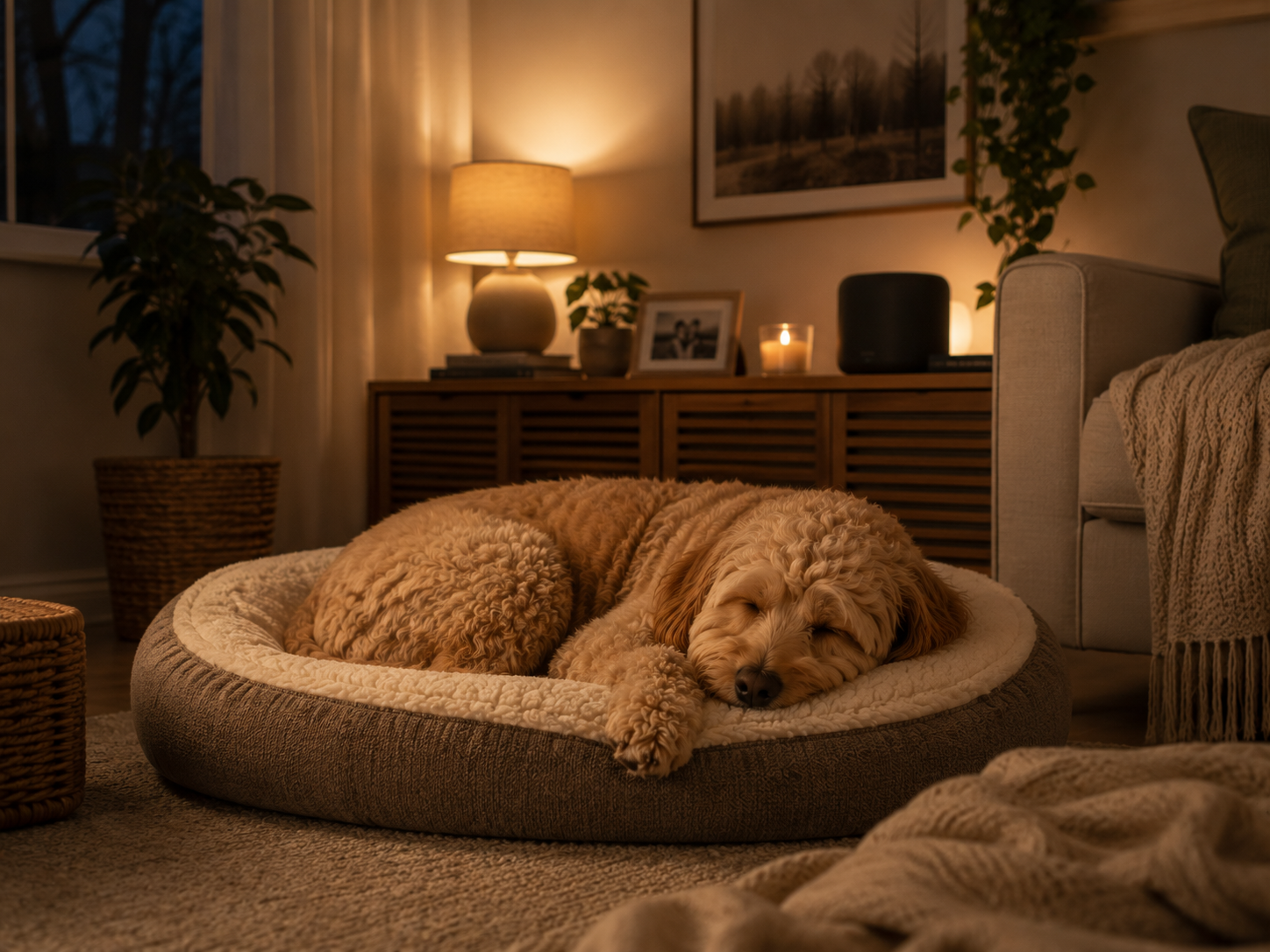
Background sound is one of the first tools many owners reach for when their dog becomes reactive to noise or unsettled when left alone. It feels intuitive: if sudden sounds trigger stress, then filling the environment with consistent sound should make things easier. In many cases, it does—but not in the way people expect. White noise, television, and calming music can reduce the sharpness of environmental triggers and create a more predictable sensory space, which is particularly useful in apartments or after events like fireworks. However, these tools do not directly resolve separation anxiety, because they do not change the underlying emotional response to being alone. The difference between managing external noise and addressing internal distress is often what determines whether sound becomes helpful or disappointing. Understanding what each type of sound actually does, where its limits are, and how to use it without relying on it as a solution allows you to integrate it into a broader, more effective approach.
Why Background Sound Feels Like the Right Solution
When a dog reacts to noise, the effect is immediate and visible. A door closes in the hallway, someone walks past the apartment, or a sudden sound comes from outside, and your dog shifts from calm to alert in seconds. These moments feel sharp, almost intrusive, because they break whatever stability was there before.
The instinct to soften this experience makes sense. Silence makes sudden sounds more noticeable. When nothing is there, everything stands out. Adding background sound reduces that contrast, making individual noises less distinct and less disruptive.
This is why owners often turn to white noise, television, or calming music after stressful events such as fireworks or storms. Even after the event itself has passed, sensitivity remains. Smaller sounds begin to carry more weight, and the environment feels less predictable.
What background sound offers in that moment is not silence, but continuity. It creates a layer between the dog and the unpredictability of the environment, which can reduce how strongly those small triggers are perceived.
What White Noise Actually Changes
White noise works by flattening the sound environment. Instead of having clear peaks and breaks—quiet followed by sudden noise—it creates a constant, even layer of sound that reduces how noticeable individual triggers are.
For dogs that react to hallway sounds, neighbors, street noise, or occasional disturbances, this can significantly reduce reactivity. The sounds are still present, but they are less defined, less isolated, and therefore less likely to trigger a response.
This becomes particularly relevant in apartment living, where dogs are exposed to constant low-level unpredictability. White noise does not remove that unpredictability, but it makes it less sharp. Instead of reacting to every small sound, the dog experiences a more continuous auditory background.
After fireworks, this effect can also help during the recovery phase. Even if the loud sounds are gone, the dog may remain sensitive to smaller noises. White noise reduces how much those noises stand out, allowing the dog’s system to settle more gradually.
What it does not do is change how your dog feels about being alone. It changes how the environment feels, not the emotional meaning of separation.
What TV and Calming Music Do Differently
Television and calming music introduce variation, but in a controlled way. Unlike white noise, which is static, these sounds create patterns—voices, rhythms, and tonal shifts that repeat over time.
For some dogs, this feels more natural than a completely flat sound. It resembles a living environment, where something is happening but nothing is threatening. Over time, these patterns can become familiar, and familiarity reduces uncertainty.
This is where routine begins to matter. When music or TV becomes part of a consistent daily pattern, it stops being just sound and starts becoming context. It signals that this is a normal part of the day, not something unusual.
Calming music, in particular, tends to work best when it maintains a slow tempo and consistent frequency range. It does not demand attention, but it creates a gentle structure that can support relaxation. If you want to explore examples designed specifically for this purpose, you can find them here:
👉 https://www.youtube.com/@qualma-app
However, just like white noise, music does not resolve anxiety on its own. It supports a calmer environment, but it does not teach your dog how to cope with being alone.
Where Sound Stops Helping
This is where expectations need to be very clear, because this is also where most frustration comes from.
If your dog is already in a state of distress when left alone, background sound will not stop that distress. It may soften certain triggers, but it will not change the core emotional experience.
Separation anxiety is not caused by silence. It is caused by the perception of being alone as unsafe or uncertain. That perception does not change because the environment sounds different.
This is why some owners see improvement and others do not. If the dog’s behavior is primarily driven by external noise, sound masking helps. If the behavior is driven by separation itself, sound becomes secondary.
It can support the process, but it cannot replace it.
How to Use Sound Without Making It Part of the Problem
Sound becomes less effective when it turns into a signal rather than a background condition.
If you only turn on music or white noise when you leave, your dog may start associating that sound with your departure. Instead of reducing stress, it becomes part of the cue that something is about to happen.
Consistency helps avoid this. Using sound as part of the general environment, rather than a departure-specific tool, keeps it neutral.
Volume also matters more than most people expect. Loud sound does not equal better results. In many cases, it increases stimulation rather than reducing it. The goal is to create a soft, consistent layer that blends into the environment, not dominates it.
Placement plays a similar role. Sound should fill the space evenly, not come from a single strong source that your dog focuses on.
What you are building is not distraction. You are building stability.
Why Observation Matters More Than Assumption
One of the most common mistakes with sound is assuming that it works without verifying it.
Without observation, it is easy to misinterpret what is happening. Your dog may appear calmer when you leave, but become reactive minutes later. Or they may ignore certain sounds, but still react strongly to others.
Using a camera changes this completely. You can see when barking starts, whether pacing decreases, how quickly your dog settles, and how they respond to different types of sound.
What becomes clear through observation is that sound rarely has a uniform effect. It works in specific areas, not across the entire behavior.
This clarity allows you to use it intentionally instead of relying on it blindly.
What to Track When You Introduce Background Sound
Tracking turns a general idea into something measurable.
Instead of asking whether sound “helps,” you begin to see how it affects specific behaviors. Does barking start later? Does pacing reduce? Does your dog settle faster or stay alert?
You also begin to see how different environments influence results. Sound may work well in one setting and less effectively in another. It may help after certain triggers but not others.
Over time, these patterns give you a much clearer understanding of where sound fits in your dog’s experience.
And once you understand that, it becomes a tool instead of a guess.
When Sound Needs to Be Part of a Bigger Approach
Sound works best when it supports something else.
If your dog is recovering from fireworks, white noise can reduce sensitivity to remaining environmental triggers. If your dog reacts to apartment noise, background sound can stabilize the environment. If your dog benefits from predictable patterns, music can become part of a routine.
But if your dog struggles with being alone itself, the core work remains the same: gradual, structured exposure that builds confidence over time.
Sound can make that process easier. It can reduce interruptions, create consistency, and support calmer states.
But it does not replace the process.
Final Thoughts
White noise, television, and calming music are often treated as solutions, but they are more accurately tools that shape the environment around your dog.
They reduce unpredictability. They soften external triggers. They create continuity where there would otherwise be disruption.
But the real change happens in how your dog experiences being alone.
When you understand that difference, sound becomes much more effective—not because it does more, but because you expect the right thing from it.
And when expectations are aligned with reality, progress becomes much easier to see.
Log tonight's session from your phone
The Qualma app is available now on Android and iPhone. Sign in with your existing account — no need to subscribe twice.