
What to Do When Neighbors Complain About Your Dog Barking
A note under the door or an email from building management turns a private struggle into a housing problem overnight. This article covers what to do in the days after a barking complaint arrives: how to acknowledge it without making promises you cannot keep, how to find out what your dog is actually doing, and what to say to a neighbor or a landlord. It also covers what reduces the noise quickly, and why bark collars make things worse.
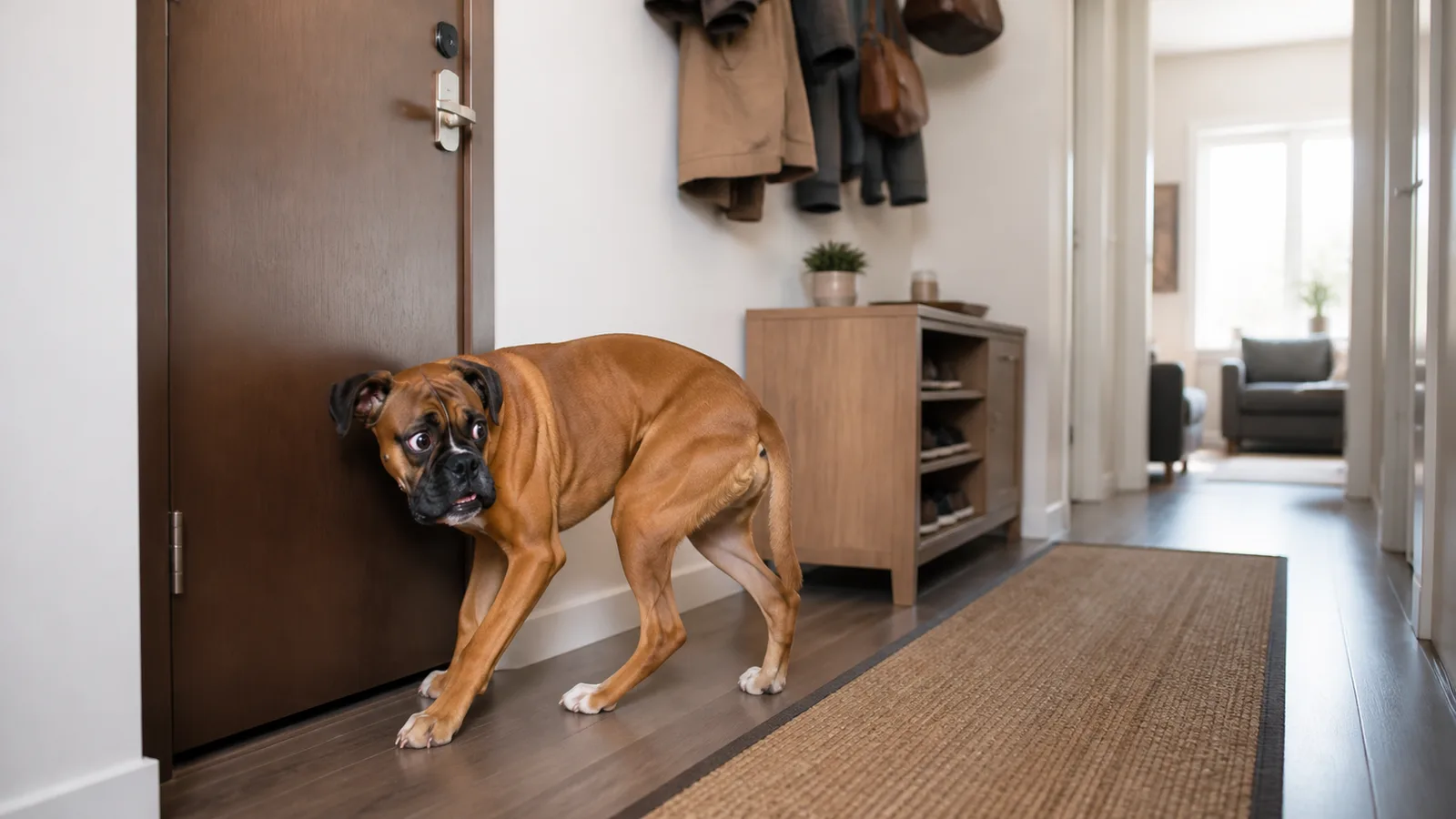
Receiving a complaint about your dog barking is a particular kind of awful. What has been a private struggle inside your own home suddenly becomes a problem involving other people, and often people who can affect where you live. Owners describe reading a note under the door or an email from building management and feeling their stomach drop, because on top of worrying about their dog they are now worrying about their housing, their reputation in the building, and a confrontation they do not know how to have. This article is about what to actually do in the days after a complaint arrives: how to find out what is really happening, how to respond to the person complaining, what genuinely reduces the noise, and what to avoid because it makes things worse.
What Should You Do First After a Barking Complaint?
Do three things before anything else, and in this order: acknowledge the complaint, find out what is actually happening, and avoid promising a timeline you cannot meet. A short reply saying you have received the message, you take it seriously, and you are looking into it will buy you a surprising amount of goodwill within a day. Most conflicts between neighbors escalate because the person complaining feels ignored rather than because of the noise itself.
Resist two very natural urges. The first is to defend your dog immediately, because a response that opens by explaining your dog is anxious reads as an excuse to someone who has not slept properly in a week. The second is to promise it will stop, because separation anxiety does not resolve in a few days and a broken promise costs you more credibility than an honest one. What you are aiming for is to be someone visibly working on a real problem, which is a far stronger position than someone insisting there is no problem.
How Do You Find Out How Much Your Dog Actually Barks?
You need real information, because the honest answer is that most owners have no idea. A complaint might describe hours of continuous barking when the reality is twenty minutes at the start of each absence, or it might turn out to be far worse than you assumed. Both situations exist, and you cannot respond sensibly or plan anything until you know which one you are in. Guessing here will make you either defensive about something real or complacent about something serious.
Set up a camera or a voice recorder for the next few absences and note when the barking starts, how long it lasts, and whether it stops on its own. A phone left recording on a shelf is enough to begin with, though we go through the options in why a camera may be the most important tool you have. What you are building is a simple record: date, time you left, when the noise started, how long it went on. That record is the foundation of everything else in this article, including the conversation with your neighbor.
What Should You Say to Your Neighbor?
Keep it short, specific, and free of excuses. Something close to this works well: "Thank you for telling me — I'm sorry, and I didn't realize how bad it was. My dog has separation anxiety and I'm working with it properly. I'm recording what happens so I know exactly when it's occurring, and I've arranged for someone to be with him on Tuesdays and Thursdays while I sort this out. If it happens again, please tell me directly rather than putting up with it."
That last sentence does more work than it looks like. It converts your neighbor from someone silently accumulating resentment into someone who tells you when there is a problem, which means you find out early and they feel heard. It also helps enormously to give them a way to reach you that is easier than a formal complaint, such as a phone number or a message on the door. People who feel they have a direct line very rarely escalate to the landlord.
If explaining any of this to another person feels mortifying, that reaction is extremely common and does not mean you are handling it badly. Owners often report that the conversation they dreaded for weeks turned out to be short and largely sympathetic. Most neighbors are not looking for a fight; they are looking for evidence that someone is listening. The social side of this problem is genuinely one of the hardest parts, and we have written about it in the hidden burden of being a separation anxiety dog parent.
What If the Complaint Comes From Your Landlord or Building Management?
Respond in writing, and respond promptly. A formal complaint needs a reply that shows three things: that you acknowledge the issue, that you have specific evidence of what is happening, and that you have a concrete plan with actions already underway. Keep it to a short paragraph or two, avoid emotional language, and attach or summarize your log if you have one. A landlord who receives a calm, organized response is dealing with a very different tenant from one who receives silence or an argument.
Name the actual steps you are taking, because vague reassurance is what makes landlords escalate. "I have booked a consultation with a veterinary behaviorist on the fourteenth, I have arranged daytime cover on Tuesdays and Thursdays, and I am tracking the noise daily" is specific and checkable. Then follow up unprompted a few weeks later with what has changed, even if the change is small. Volunteering an update is the single strongest signal that someone is genuinely dealing with a problem.
Can You Be Evicted Over a Barking Dog?
It depends entirely on where you live and what your tenancy agreement says, and this article cannot tell you the answer for your situation. What is generally true is that formal action is usually a last step rather than a first one, and that it tends to follow a pattern of complaints with no visible response from the tenant. This is precisely why documenting your response matters so much. A record showing you replied, investigated, and took concrete steps changes the picture considerably.
The practical advice is to read your tenancy agreement or building rules now rather than when things have escalated, so you know what you have actually agreed to about noise and pets. If a formal process does begin, that is the point to get proper advice from a tenant's advice service, a housing charity, or a lawyer, rather than relying on general guidance. Knowing your position early is far less stressful than discovering it under pressure.
What Actually Reduces the Noise While You Work on the Cause?
The fastest thing you can do is stop your dog being alone for the stretches that cause the worst barking, which is also the thing that helps the underlying problem. Arranging cover for the worst two or three absences in the week often removes most of the noise your neighbors are hearing, and it does so immediately rather than in three months. This is not avoidance of the real work; it is the foundation the real work is built on, because a dog rehearsing panic every day cannot make progress.
Alongside that, a few smaller changes reduce the noise your neighbors actually hear. None of them fix the anxiety, and none should be treated as a substitute for the work above. They are worth doing because they buy you goodwill and quiet while the real training takes effect:
- Move your dog to the quietest room. A room away from the shared wall, the front door, and the hallway usually reduces both what triggers the barking and what your neighbors hear.
- Use sound to mask outside noise, not to mask your dog. Background sound can stop hallway footsteps setting your dog off, which is genuinely useful. It will not stop distress barking on its own, as we cover in what white noise, TV and music can and cannot do.
- Block the visual triggers. If your dog barks at the window or at movement in the corridor, film on the glass or a closed internal door removes a whole category of barking that has nothing to do with anxiety.
- Tell your neighbor when you are working on it. A neighbor who knows you are running training sessions between two and three is far more tolerant of noise in that window.
What Should You Avoid?
Avoid anything that punishes the barking, including bark collars, citronella or ultrasonic devices, and shouting at your dog on your return. These can suppress the noise while leaving the fear completely intact, which means your neighbors may hear less while your dog is doing worse. For a dog barking out of panic, adding something unpleasant to the situation gives them one more thing to be frightened of, and the barking usually returns worse once the device stops working or the dog habituates to it.
Also avoid the advice to simply leave your dog alone for longer so they get used to it. This is one of the most persistent ideas owners are told and one of the most damaging, which we take apart in the myths that stop dogs from getting better. In a building with neighbors, it is also the approach most likely to generate the next complaint, because it guarantees more hours of noise rather than fewer.
How Do You Show That You Are Taking It Seriously?
Keep a written record, because it protects you in a way nothing else does. One line per absence is enough: the date, the time you left, when the barking started, how long it lasted, and what you had arranged that day. After three or four weeks this becomes something you can show a landlord, and it is far more persuasive than any assurance you could offer verbally. It also lets you see whether things are improving, which is very difficult to judge from memory when you are stressed.
Add a second short list of the actions you have taken, with dates: when you contacted a vet or behaviorist, when you arranged cover, when you moved the dog's room, when you last updated your neighbor. Between them, these two records turn "I'm doing my best" into something concrete. If the situation ever becomes formal, having them already written is worth a great deal.
What To Do This Week
Reply to the complaint today, even if you have no plan yet, because the acknowledgment is what stops the situation escalating while you work out what to do. Keep it to three sentences: you have received it, you are sorry, and you are looking into it properly. Then set up a recording for the next absence, so that by the end of the week you know what is actually happening rather than what you fear is happening.
Once you have two or three days of recordings, look at which absence produces the worst noise and solve that one first. For most households it is a single stretch of the week rather than every day, and removing it usually removes the majority of what the neighbors hear. That is the fastest route to a quieter building, and it happens to be the same first step your dog needs anyway.
Log tonight's session from your phone
The Qualma app is available on Android now, with iOS coming soon. Sign in with your existing account — no need to subscribe twice.