
Why Your Dog Cries When You Leave the Room
Some dogs do not wait for you to leave the house. They start when you stand up, walk toward the bathroom, or close a door between you for thirty seconds. This is usually separation anxiety at a smaller scale, and the common advice to leave and let them settle makes it worse. This article explains what a micro-absence is, gives you a starting ladder for when you cannot even close a door, and answers whether you should comfort a crying dog.
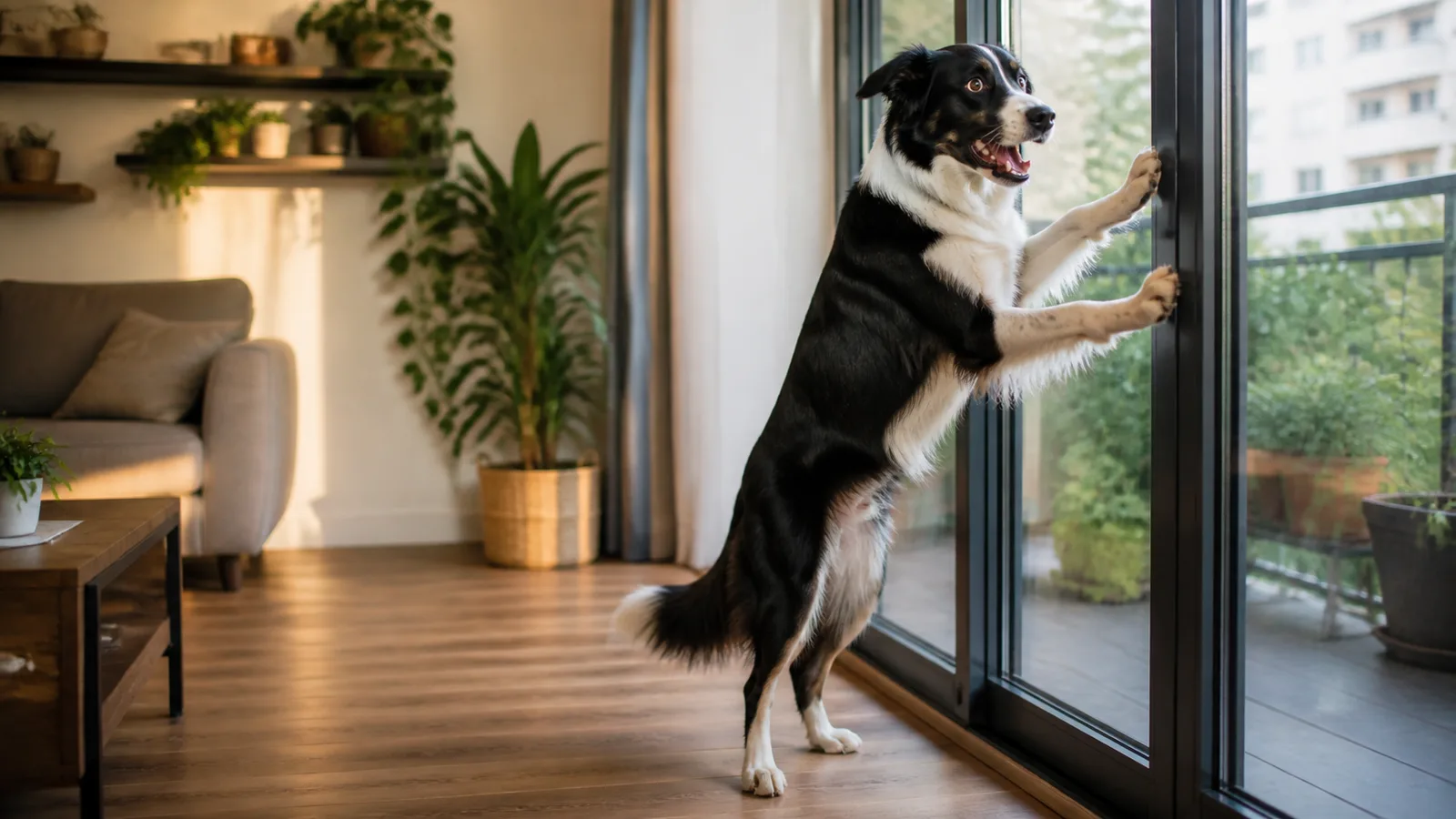
Some dogs do not wait for you to leave the house to become distressed. They start when you stand up from the sofa, when you walk toward the bathroom, or when a door closes between you for thirty seconds. For the owner, this is a strange and exhausting problem to live with, because it turns ordinary things like showering, cooking, or working in another room into events that have to be managed. It is also frequently misunderstood as a dog being spoiled, needy, or badly behaved, when what is actually happening is that your dog cannot yet cope with even a small amount of distance from you. This article explains what is going on, why the usual advice to "just leave and let them settle" makes it worse, and exactly where to start when you cannot currently close a door.
Why Does My Dog Cry When I Leave the Room?
Your dog cries when you leave the room because, for them, the distance itself is the problem rather than the length of time. A dog who has learned that being apart from you feels frightening does not distinguish between you being in the kitchen and you being at work. Both are the same category of event, and the panic starts at the moment the separation begins rather than building slowly over hours. This is why a dog can be perfectly quiet for a two-hour nap beside you and start screaming forty seconds after a bathroom door closes.
It helps to understand that this is an emotional reaction rather than a decision. Your dog is not weighing up whether to make a fuss, and they are not doing it to get your attention in the way owners are often told. The behavior you see — whining, scratching, barking, or pushing at the door — is what distress looks like coming out, not a strategy. Treating it as manipulation leads people toward exactly the approaches that make it worse.
Is This the Same Thing as Separation Anxiety?
It is usually the same underlying problem showing up at a smaller scale. Most dogs who panic when their owner leaves the house also struggle with these in-home separations, and the in-home version often appears first. Some dogs, though, only show it inside the house and are genuinely fine when left properly alone, which sounds contradictory until you realize that what upsets them is losing access to you rather than being by themselves. Either way, the approach to fixing it is the same.
The distinction that matters more is between a dog who simply likes being near you and a dog who becomes distressed when they cannot be. Plenty of dogs follow their owners around the house perfectly happily and settle without complaint when a door closes, and that is normal companionship rather than a problem to fix. We go through how to tell those two apart in why your dog follows you everywhere. If your dog follows you but settles calmly when they cannot, you probably do not need this article.
What Is a Micro-Absence?
A micro-absence is a separation so short and so small that your dog does not have time to become worried by it. In practice that might mean standing up and sitting back down, walking to the doorway and returning, or stepping out of sight for two seconds. It sounds almost too small to be worth doing, and that reaction is the single most common reason people fail at this. The whole method depends on the absences being genuinely easy for your dog, because you are trying to build a history of separations that ended before anything bad happened.
The logic is straightforward once you see it. Every time your dog experiences a separation and stays calm through it, that experience becomes a small piece of evidence that separations are survivable. Every time they experience one and panic, it becomes evidence in the other direction. You are trying to stack up as many of the first kind as possible, which means keeping each repetition well within what your dog can currently handle rather than testing what they can just about survive.
Where Do You Start If You Cannot Even Close a Door?
You start below the door, which surprises most people. If closing the bathroom door for five seconds already causes crying, then five seconds behind a closed door is not your starting point — it is several steps beyond it. Begin instead with the smallest version of the movement that produces no reaction at all, and be prepared for that to be very small indeed.
A realistic first ladder is made of steps far smaller than most owners would think to try. Work through it in order, practicing each rung until it is genuinely boring before you move up to the next one. Do not skip ahead because a step seems too easy, because easy is exactly what you are aiming for:
- Stand up from where you are sitting, then sit back down.
- Stand up, take two steps toward the door, and come back.
- Walk to the doorway, touch the door frame, and return.
- Touch the door handle, then return without moving the door.
- Move the door a few inches, then return.
- Close the door fully with you still on your dog's side.
- Step through the door, close it, and reopen it immediately.
Notice that your dog is not left alone at all for most of that list. You are working on the parts of the sequence that already predict separation, which is why the reaction often starts before you have actually gone anywhere. Your dog has learned to read the early signals, and those signals are what you are defusing first. The same principle applies to leaving the house, which we cover in breaking departure cues.
How Long Should Each Repetition Last?
Short enough that you come back before your dog becomes worried, which usually means shorter than feels sensible. If you are behind a closed door and your dog is quiet for four seconds and starts shifting at five, your repetition should be two or three seconds. Returning while your dog is still calm is the entire point, because what you are teaching is that the door opens again long before anything frightening happens. Waiting for them to settle after becoming upset teaches something completely different.
It also helps to vary the length rather than steadily increasing it. If every repetition is longer than the last, your dog quickly learns that each separation predicts a worse one, and they start becoming anxious at the beginning rather than the end. Mix two seconds with eight, then four, then one, so there is no pattern to brace against. Progress comes from the average creeping upward over sessions, not from beating your record every time.
Should You Comfort a Dog Who Is Crying?
Yes, and the widespread advice not to is one of the most damaging myths in dog training. Comforting a frightened dog does not reward the fear or make it more likely, because fear is an emotional state rather than a behavior being reinforced. A dog who is panicking and then receives reassurance does not learn to panic more; they learn that you come back and that distress is survivable. We take this apart alongside several other persistent ideas in the myths that stop dogs from getting better.
The more useful question is what the crying is telling you about your plan. If your dog is regularly becoming distressed during practice, the answer is not to harden yourself against it but to make the steps smaller. Crying during a training session is information that you have gone too far, too fast — it is feedback rather than something to endure. Adjust the difficulty and the crying largely disappears, which is a far better outcome than learning to ignore it.
Why Does My Dog Seem to Be Getting Worse?
The most common cause is that careful practice is happening alongside real separations that are far beyond what your dog can handle. If you spend ten minutes doing two-second door repetitions and then shower for fifteen minutes with your dog screaming outside, the shower is the more powerful experience. This is not a reason to stop washing, but it is a reason to solve the real-life separations in parallel rather than hoping the training will outrun them. Anything that stops your dog rehearsing full panic will speed everything else up.
The second common cause is moving too quickly because a session went well. One good repetition at eight seconds does not mean eight seconds is now your baseline, and treating it that way is how people end up back at the beginning. Progress in this work is genuinely slow and uneven, and expecting otherwise is its own kind of setback — something we have written about in letting go of unrealistic expectations. A step that felt easy on Sunday can be too hard on Wednesday, and that is normal rather than a loss of progress.
How Do You Know When to Move Up a Step?
Use your dog's body rather than the clock, and look for a genuine absence of reaction rather than the absence of noise. Your dog should stay lying down, keep breathing normally, and not lift their head sharply or track your movement across three or four repetitions in a row before you make anything harder. If they get up, stare at the door, or freeze in place, that step is still too hard even if they made no sound at all. Silence and calm are not the same thing, and learning to read the difference is genuinely the skill that this work depends on — we cover the signals most owners miss in how to tell if your dog is stressed.
When a step is boring three times running, move up by the smallest increment you can think of. If that next step produces a reaction, go back two rungs rather than one, and rebuild from there. Dropping back is not lost progress; it is how the method is supposed to work, and the ground you cover the second time is usually covered much faster.
What To Do This Week
Pick one situation and one situation only, ideally the one that makes your daily life hardest. For most households that is the bathroom, because it happens every day and cannot be avoided. Work out the largest version of that movement your dog can watch without reacting at all, which might be as little as walking toward the door and turning around, and do five relaxed repetitions of it once or twice a day. Keep the sessions short enough that you stop while your dog is still calm and slightly bored.
Then write down what you did and what your dog's body was doing, because this work is almost impossible to judge from memory. Three lines a day is enough: what the step was, how many repetitions, and whether your dog stayed settled. Within a week or two you will have something far more useful than an impression, and you will be able to see progress that is much too gradual to notice day by day.
Log tonight's session from your phone
The Qualma app is available now on Android and iPhone. Sign in with your existing account — no need to subscribe twice.