
I Feel Like a Hostage to My Dog’s Anxiety
Feeling trapped by your dog’s separation anxiety? Learn why this happens, how it affects your life, and what actually helps you regain balance without hurting your dog’s progress.
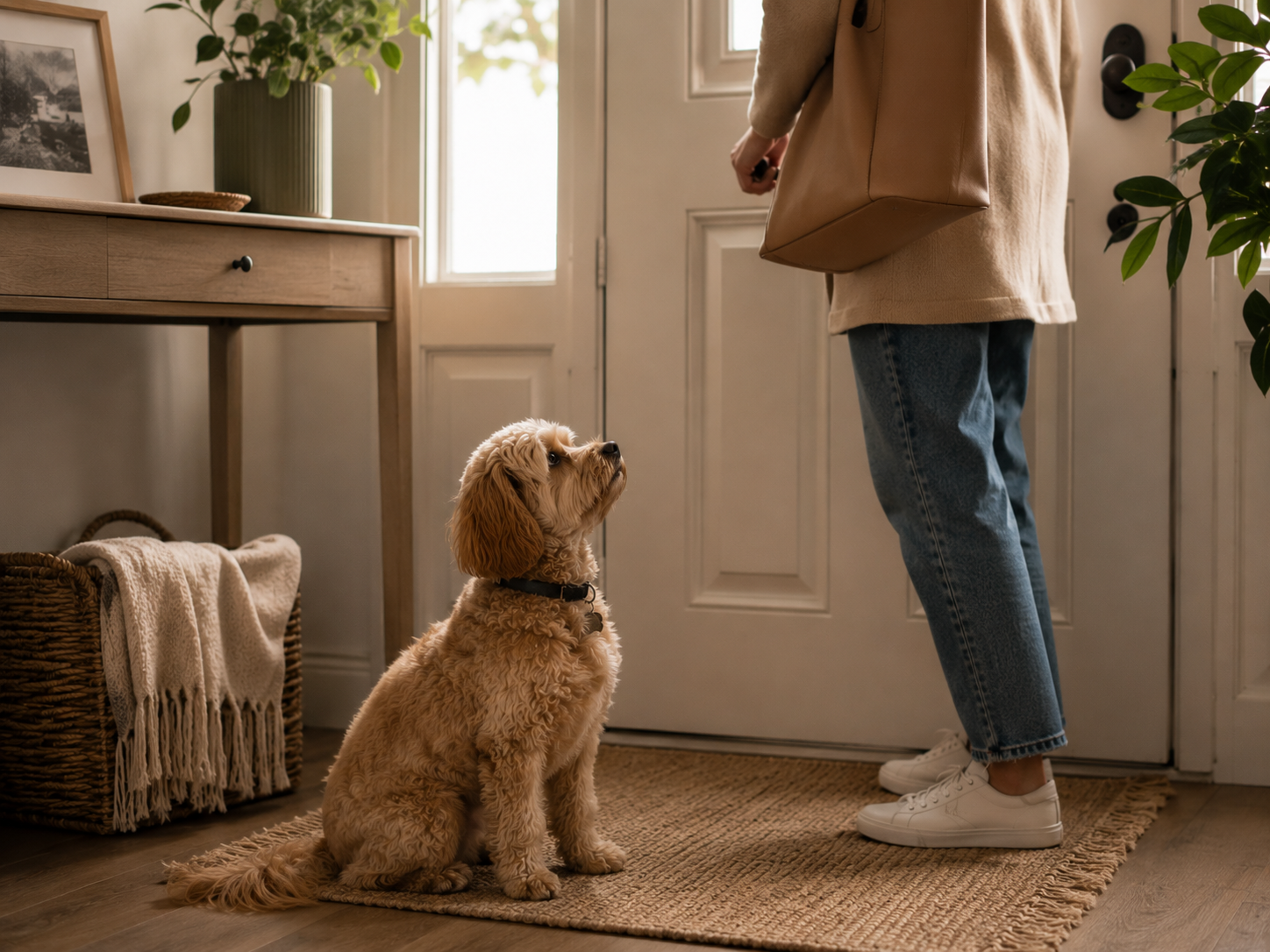
Living with dog separation anxiety changes more than your dog’s behavior — it changes your life in ways that are often difficult to explain to other people. What starts as a manageable training challenge can slowly become something that affects your routines, your decisions, and your sense of freedom. Many owners describe feeling like they cannot leave the house without consequences, which creates a quiet but persistent feeling of being trapped. This experience is far more common than most people admit, especially when a dog’s anxiety is still in progress and unpredictable. Understanding why this feeling develops is just as important as understanding the dog’s behavior, because the emotional load on the owner directly affects how sustainable the process becomes. When you look at separation anxiety not only as a dog problem but as a shared system between you and your dog, it becomes easier to find a way forward that supports both of you.
When Dog Separation Anxiety Starts Shaping Your Life
There is a moment that many owners recognize, although it rarely comes all at once. You begin noticing how often your plans depend on your dog’s ability to stay alone. It might start with small adjustments — staying home instead of going out, leaving earlier to reduce absence time, or checking your phone repeatedly to see how things are going.
Over time, these adjustments stop feeling temporary. They become part of how you live.
Dog separation anxiety does not just affect the dog when you leave. It affects everything that leads up to that moment. You start thinking ahead constantly, trying to predict how your dog will react. Even when nothing is happening, the question is there in the background: can I leave, and what will happen if I do?
This is where the feeling of being trapped begins. Not because you have no options, but because every option carries weight.
Why This Feels So Different From Other Dog Behavior Problems
Most dog behavior challenges are situational. A dog pulls on the leash during a walk, barks at strangers, or reacts to specific triggers. These situations are contained. They have a beginning and an end.
Separation anxiety is different because it follows you into your decisions.
You are not reacting to something happening in front of you. You are constantly anticipating something that might happen when you are not there. That anticipation creates a different type of pressure, one that does not switch off easily.
The responsibility also feels heavier. If your dog struggles when alone, you are aware of it even when you are not physically present. That awareness changes how you experience absence itself.
It is no longer neutral.
The Emotional Cost of Always Planning Around Your Dog
Planning is not the problem. The problem is when planning becomes constant.
You begin structuring your day around your dog’s tolerance. You measure time differently. You evaluate opportunities based on how they fit into your training progress. You think about distance, duration, and timing in a way that most people never have to consider.
This level of awareness is not wrong. In fact, it often comes from being a very responsible owner. But it is also exhausting.
The feeling of being trapped does not come from one big limitation. It comes from many small ones that add up. Each decision becomes slightly heavier, slightly more complex, slightly more restricted.
And over time, that accumulation changes how your life feels.
Why Feeling Trapped Does Not Mean You Are Doing Something Wrong
This is one of the most important things to understand.
Feeling trapped by dog separation anxiety does not mean you are failing. It means you are carrying responsibility in a situation that has no immediate resolution.
You are balancing your dog’s needs with your own life. You are trying to make the right decisions without perfect information. You are adjusting as you go.
That is not failure. That is effort.
The difficulty is that separation anxiety does not provide quick feedback. Progress is gradual, and setbacks can feel disproportionate. This makes it harder to trust the process, especially when your daily experience still feels restricted.
What Actually Helps — And What Doesn’t
When people feel trapped, the instinct is often to look for a solution that removes the problem entirely. But separation anxiety does not resolve in one step, and expecting it to do so increases frustration.
What helps is not one single change, but a combination of adjustments that reduce pressure on both sides.
For your dog, this means consistent, gradual training that builds confidence with being alone. It also means avoiding situations where they are pushed beyond their current threshold, because those experiences reinforce the anxiety you are trying to reduce.
For you, it means creating space within the process. This can include finding support systems such as sitters, daycare, or trusted people who can step in when needed. It can also mean adjusting expectations so that progress is sustainable, not rushed.
The goal is not to eliminate all limitations immediately. The goal is to make the situation manageable enough that you can continue.
Reframing the Situation Without Minimizing It
It is important not to dismiss how this feels. Saying “it will get better” is not helpful when you are living it every day.
At the same time, it helps to reframe what is happening.
You are not permanently trapped. You are in a phase where your dog’s current abilities create temporary limits. Those limits are not fixed. They change as your dog learns and adapts.
This does not make the present easier, but it changes how you interpret it.
Instead of seeing your life as restricted, you begin to see it as temporarily structured around a process that is still moving.
Why Your Experience Matters in the Process
Separation anxiety is often treated as something that only affects the dog, but that perspective is incomplete.
Your experience influences how consistent you can be, how you respond to setbacks, and how sustainable your training approach is over time. If you feel overwhelmed or restricted, it becomes harder to maintain the balance required for progress.
This is why helping the owner is not separate from helping the dog. It is part of the same system.
When your life becomes more manageable, your decisions become clearer. And clearer decisions support better outcomes for your dog.
Finding a Way Forward That Works for Both of You
There is no version of this process where everything becomes easy immediately. But there is a version where it becomes manageable.
That version is not built on perfect training or perfect routines. It is built on understanding, adjustment, and realistic expectations.
Your dog’s separation anxiety will improve over time if the approach is consistent and aligned with how they learn. At the same time, your life does not have to stay as restricted as it feels right now.
The balance is not immediate, but it is possible.
Final Thoughts
Feeling trapped by dog separation anxiety is not something you imagine. It is a real experience that comes from carrying responsibility over time without clear boundaries.
But it is not permanent.
Your dog is learning. You are adapting. The system is changing, even if it feels slow.
The goal is not to remove all difficulty. The goal is to move from feeling controlled by the situation to feeling capable within it.
And that shift, once it starts, changes everything.
Log tonight's session from your phone
The Qualma app is available now on Android and iPhone. Sign in with your existing account — no need to subscribe twice.