
How to Move Your Dog Out of the Crate
Deciding the crate is not working is often the easy part. What comes after is rarely explained: how to actually move a dog who associates being alone with being confined, without producing chewed skirting boards or a dog who cannot settle anywhere. This article covers the transition itself, from crate to pen to a gated room to genuine free roam, at a pace that protects the progress you have already made instead of undoing it.
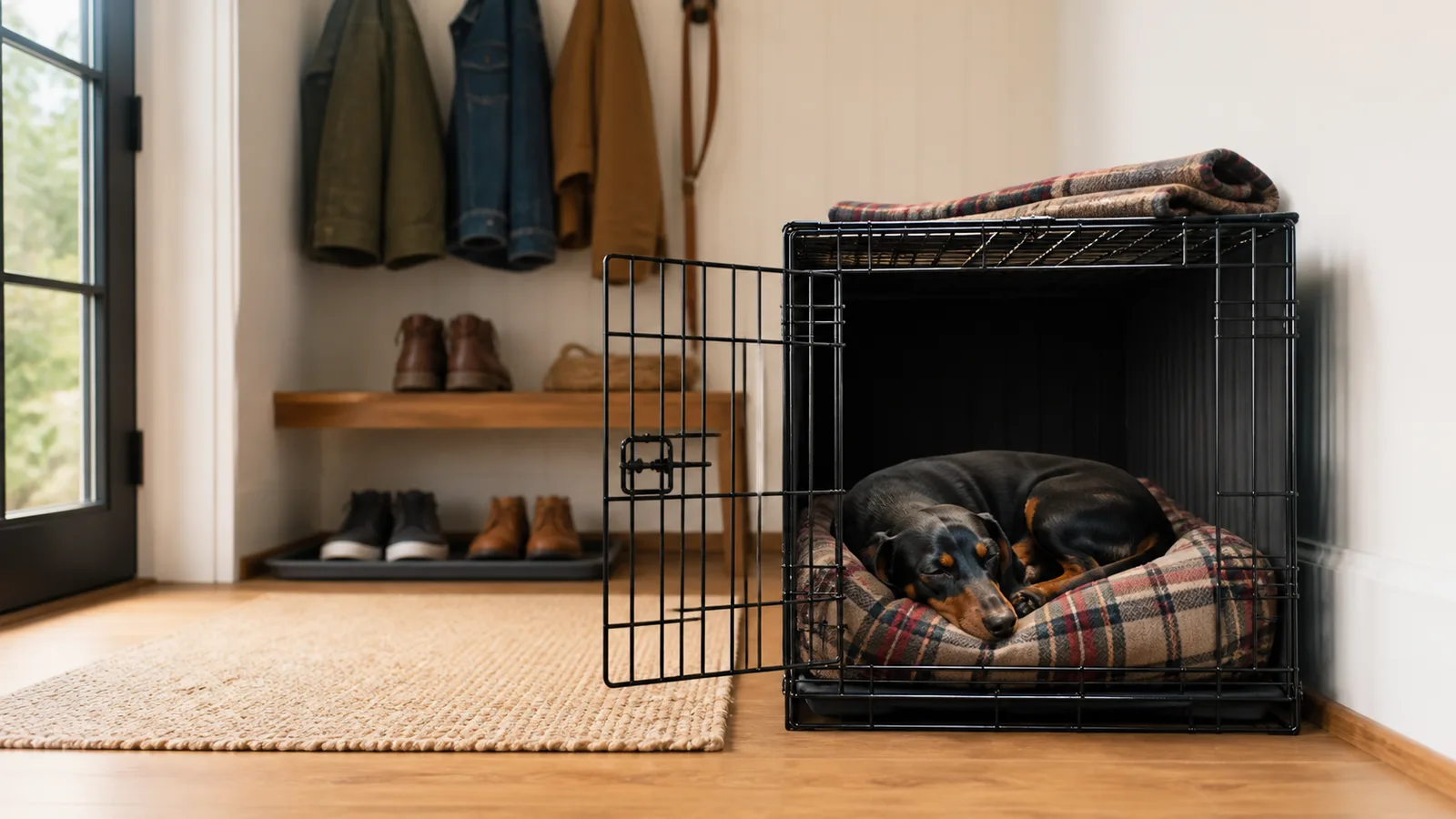
Deciding that the crate is not working for your dog is often the easy part. What comes after is the part nobody quite explains: how do you actually move a dog who has spent months or years associating being left alone with being confined? Simply opening the door and hoping for the best tends to produce chewed skirting boards, a dog who cannot settle anywhere, or both. This article covers the transition itself, moving from a crate through a pen and a gated room to genuine free roam, at a pace that protects the progress you have already made rather than undoing it.
Why Does Removing the Crate Suddenly Cause Problems?
Because the crate was doing more work than it looked like it was doing. Even a crate your dog dislikes usually provides a small, defined space, which some dogs find easier to settle in than a whole room of open options. Taking that away all at once removes a structure your dog was relying on, whether or not that structure was actually helping their anxiety.
There is also a practical dimension that has nothing to do with emotions. A crate contains mess, prevents access to things that can be chewed or swallowed, and limits how far a panicking dog can travel or how much damage they can do. Removing it without a plan for those three things is what turns a reasonable decision into a chaotic few weeks, and it is entirely avoidable with a bit of sequencing.
What Should Replace the Crate First?
An exercise pen or a gated single room, not the whole house. This middle step gives your dog more space than the crate while keeping the area small enough to remain manageable, both for their sense of security and for practical things like accidents and chewing. Choose a room your dog already associates with something calm, ideally where they already choose to rest during the day. If you are unsure why the crate itself became part of the problem for your dog rather than part of the solution, that decision is covered in should you crate a dog with separation anxiety.
Resist the pull to skip straight to full free roam because the crate clearly was not working. The pen or gated room is not a lesser version of the goal; it is the step that makes the goal achievable without a setback. Dogs who go from a crate straight to an entire home, unrestricted, are the ones most likely to end up back in a crate a few weeks later after things went badly.
How Do You Introduce the Pen or Gated Room?
Set it up while you are home first, well before you ever test it during an absence. Let your dog spend ordinary time in the space with you nearby, with their bed, water, and something to occupy them, so the area itself becomes familiar before it is ever associated with your leaving. This is the same principle behind any change to where your dog rests: familiarity has to come before the difficult event, not during it.
Once the space feels normal to your dog, begin testing short absences from it rather than jumping to your usual length of time away. Use whatever length you know your dog can currently manage without distress, which may be considerably shorter than what they tolerated in the crate, since the space itself has changed even if the door position has not. Building back up from there follows the same principle as any separation training: short, successful repetitions rather than a single long test.
What If Your Dog Panics in the New Space?
Treat it as information rather than a sign the whole plan has failed. If your dog is markedly more distressed in the pen or room than they were in the crate, that tells you something genuinely useful: the crate may have been providing more security than you realized, or the new space may need adjusting before your dog is ready for it. Neither of those is a reason to abandon the transition, only a reason to slow it down.
Go back to a shorter absence than the one that triggered the reaction, and rebuild more gradually from there. It can also help to make the new space feel more enclosed at first — positioning the pen against a wall rather than in the open, or using a smaller room before a larger one — so the change from the crate feels less abrupt. A dog who is struggling with the size of the space is not a dog who cannot do this; they are a dog who needs a smaller version of the step you just tried.
When Are You Ready to Move to a Gated Room From a Pen?
When your dog is reliably settling in the pen for real absences, not just for short supervised sessions with you present. Reliable here means several successful absences at your dog's current maximum, not one lucky day, since a single good outcome is not the same as a pattern you can build on. If you are unsure whether what you are seeing is genuine settling or something quieter that looks similar, it is worth checking rather than assuming.
A dog who is still, silent, and apparently calm is not automatically a dog who is coping. Some dogs shift from obvious distress into a frozen, watchful stillness that looks like progress from a glance but is not, and telling the two apart matters enormously here. We go through exactly how to read that difference in calm or a freeze response, and it is worth checking your dog against that before moving on to more space.
How Do You Get From a Gated Room to Free Roam?
Widen the space gradually, room by room, using the same absence-length logic you used for every earlier step. Open the gate to include a second room while you are home first, let your dog get used to the larger footprint, then test a short absence in that expanded space before adding anything further. Each addition is a genuine change from your dog's perspective, even though it feels like a small adjustment from yours.
There is no fixed number of steps this has to take, and rushing it to hit a timeline is how progress gets undone. Some dogs move through this in a matter of weeks; others take considerably longer, particularly if earlier steps in their separation anxiety training were also gradual, which is normal rather than a sign of a wrong approach — the same predictability that supports separation training generally supports this transition, as we cover in why routine helps dogs with separation anxiety. The pace that works is the one your dog's behavior is actually telling you, not the one you had hoped for when you started.
What Should You Puppy-Proof or Dog-Proof Before Widening Access?
Treat each new room the way you would for a new puppy, regardless of your dog's age, because a dog given new freedom during an anxious moment may chew or interact with things they would ordinarily ignore. Secure trailing cables, remove anything genuinely dangerous if swallowed, and put away anything irreplaceable until you have more evidence of how your dog handles the space unsupervised. This is not about assuming the worst; it is about not finding out the hard way.
Pay particular attention to exits. Balcony doors, windows a determined dog could push through, and any gap a stressed dog might squeeze into or try to escape from are worth checking in every new room before you leave your dog alone in it. A few minutes of checking now is considerably better than discovering a problem while you are out.
What If Your Dog Does Better With Some Structure Permanently?
That is a completely legitimate outcome, not a failure to reach some universal goal of full free roam. Some dogs are simply more settled with a defined space, a gated room, or a section of the house, even once their anxiety has improved considerably. The purpose of this whole process is finding what actually helps your particular dog, not reaching a specific endpoint because it sounds like the healthiest option.
If a gated room ends up being where your dog is happiest long-term, that is a good outcome and not a consolation prize. The comparison that matters is your own dog's wellbeing before and after this process, not a comparison against what other owners have arrived at with their dogs. Chasing full free roam for its own sake, past the point where your dog is genuinely thriving, helps nobody. What you are actually working toward is the amount of space your particular dog can enjoy without it costing them their sense of security.
What To Do This Week
If you have already decided the crate is not working, do not remove it and open the whole house at once. Set up a pen or gate off a single room today rather than waiting for a more convenient weekend. Let your dog spend ordinary time there with you present, first with the door open and then briefly closed, so the space itself becomes familiar. Only test a short absence from it once that familiarity is genuinely established, not on the same day you set it up.
Then run that first absence at a length you already know your dog can manage, even if it feels overly cautious given how long they have been out of the crate. A boring, successful first test in the new space is worth far more than an ambitious one that sets you back to where you started. It is genuinely the foundation for every step that follows, including the ones that feel much further away right now. Getting this first one right is what makes the rest of the transition move quickly rather than slowly.
Log tonight's session from your phone
The Qualma app is available now on Android and iPhone. Sign in with your existing account — no need to subscribe twice.