
Should You Crate a Dog With Separation Anxiety? When It Helps and When It Hurts
Should you crate a dog with separation anxiety? Learn when a crate helps create calm—and when it increases panic, stress, and safety risks.
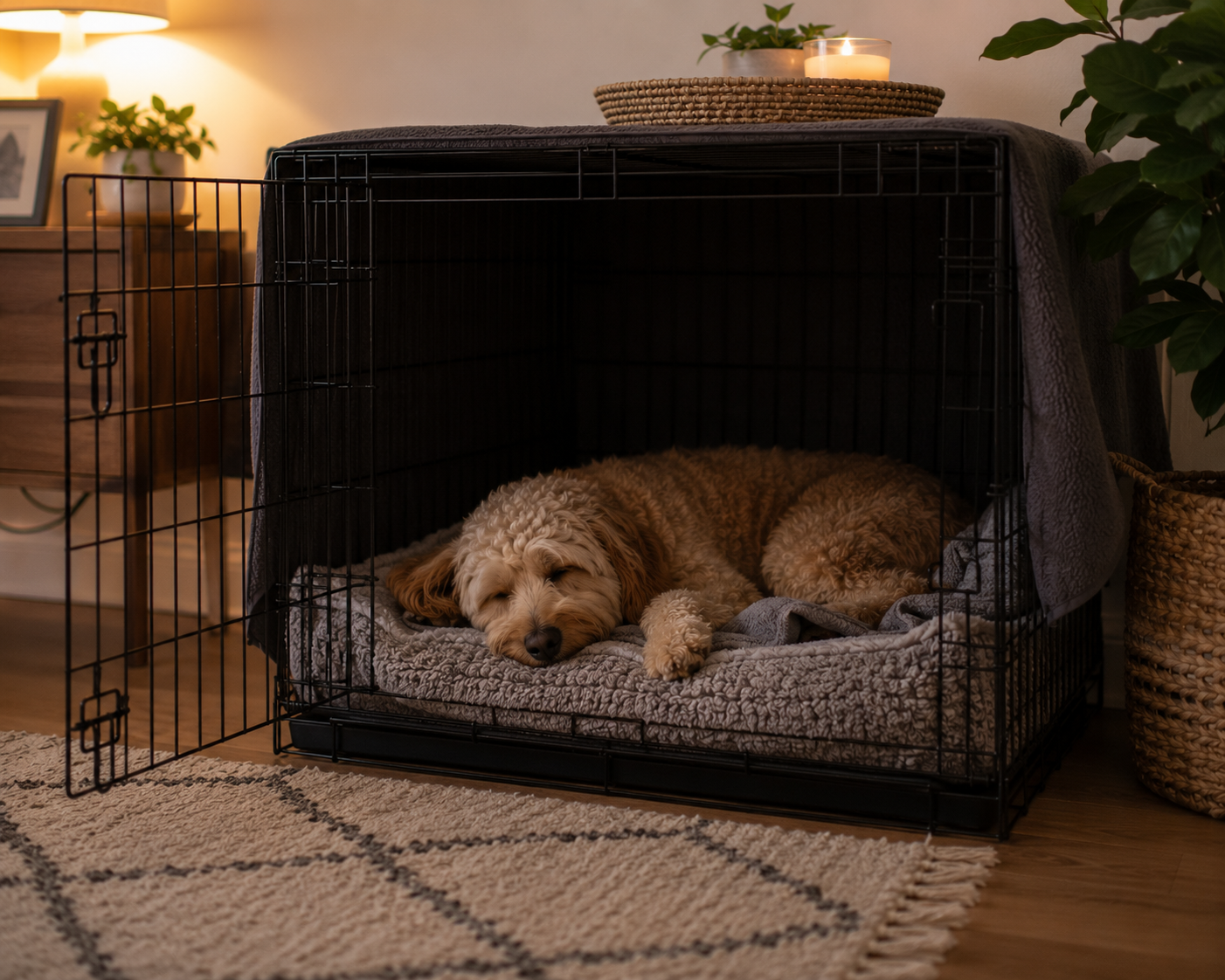
Crate training is one of the most widely recommended tools in dog training, yet it becomes one of the most debated topics the moment separation anxiety enters the picture. Owners are often given completely opposite advice, sometimes within the same conversation, and both sides can sound equally convincing. This creates a situation where the decision feels high-stakes but unclear, especially when safety and emotional wellbeing are involved at the same time. The difficulty comes from the fact that a crate does not have a fixed effect—it amplifies whatever emotional state the dog is already experiencing. For some dogs, it reduces stimulation and creates a sense of containment that supports calmness, while for others it removes control and intensifies panic. Understanding the difference requires looking beyond general advice and focusing on how your individual dog responds under specific conditions. When you approach the crate as a variable rather than a solution, the decision becomes clearer, and the risk of making the situation worse becomes much lower.
Why Crate Advice Becomes So Contradictory
The reason crate advice feels inconsistent is not because one side is wrong, but because the context keeps changing while the recommendation stays the same.
In many areas of training, crates are extremely effective. They help create structure, reduce environmental distractions, and provide a defined space where the dog can rest. When introduced gradually and associated with calm states, they can become a reliable part of daily routine.
But separation anxiety changes the meaning of confinement.
The problem is no longer about where the dog is, but how the dog feels when they are alone. Once emotional distress is involved, the crate is no longer just a physical space. It becomes part of the experience of that distress.
This is where the same tool produces opposite outcomes.
For one dog, the crate reduces complexity and supports settling. For another, it removes options and increases pressure. The advice does not change, but the internal state of the dog does.
And that is why the results feel unpredictable.
When the Crate Is Actually Helping
A crate supports calmness when it aligns with how your dog already regulates themselves.
Some dogs naturally settle better in smaller, enclosed spaces. The boundaries reduce the amount of input they need to process, and that reduction allows their system to relax. In these cases, the crate becomes less of a restriction and more of a filter.
You can usually recognize this before separation is even involved.
The dog enters the crate without hesitation, remains relaxed when the door is closed, and shows the same ability to settle whether you are nearby or slightly out of sight. Their body language remains soft, their breathing stays even, and they are able to rest rather than monitor.
In this situation, the crate is not creating calmness. It is supporting a state that already exists.
And because that state is stable, it can carry into short periods of absence without immediately breaking.
When the Crate Becomes Part of the Problem
The same setup can produce a completely different reaction if the dog does not experience confinement as safe.
For dogs that rely on movement, proximity, or environmental control to regulate themselves, the crate removes those options. Instead of reducing stimulation, it increases internal pressure.
This is where you begin to see escalation rather than settling.
The dog may hesitate to enter, remain alert instead of resting, or shift into active attempts to leave. Once separation is added, the reaction can intensify quickly, because the crate now represents both confinement and absence at the same time.
This is often described as a dog that “panics in the crate when left alone,” but the crate itself is not the root cause. It is amplifying the existing anxiety by removing coping strategies.
And when that happens repeatedly, the association becomes stronger, not weaker.
The Risk That Goes Beyond Behavior
When a dog becomes distressed in a crate, the issue is no longer only behavioral.
Dogs that attempt to escape confinement do not do so carefully. They push, bite, claw, and force movement against fixed surfaces. This can lead to injuries that are not immediately obvious but can become serious over time.
Teeth can be damaged from biting metal bars. Paws can be injured from repeated impact or getting caught. Some dogs attempt to squeeze through spaces that are not large enough, creating additional risk.
These outcomes are not extreme scenarios. They are what happens when emotional pressure meets physical restriction.
This is why the decision to use a crate cannot be based on theory alone. It has to include observation of how your dog actually responds.
What Changes When You Look at the Dog, Not the Tool
The most useful shift in this decision is moving from “does a crate work” to “what does my dog do in this environment.”
The crate does not define the outcome. The dog’s response does.
This means the decision cannot be made in advance. It has to be observed in real conditions, at a scale that does not create stress.
Short exposures, controlled situations, and careful observation reveal more than any general recommendation. You see whether the dog settles or escalates, whether they remain relaxed or become alert, whether the space reduces complexity or increases pressure.
Once you see that, the answer is no longer theoretical.
When Alternatives Make More Sense
For dogs that do not tolerate crates well, the solution is not to remove structure, but to adjust it.
A safe room, a gated area, or a pen provides boundaries without the same level of confinement. The dog retains some control over movement, which can be enough to prevent escalation while still limiting the environment.
These setups often work better for dogs that need space to regulate but still benefit from reduced complexity.
The goal is not to maximize freedom or restriction, but to find the point where your dog can remain calm without losing stability.
And that point is different for every dog.
Testing Without Creating a Problem
Testing whether a crate works should never involve pushing your dog into a situation they cannot handle.
This is where many setbacks begin.
The purpose of testing is to observe, not to prove. Short durations, low pressure, and the ability to stop before escalation are what make testing useful instead of harmful.
A camera becomes essential here, because it shows what happens beyond the moment you leave. You can see how quickly your dog reacts, whether they settle, and whether the state changes over time.
Without that information, it is very easy to misinterpret what is happening.
When to Bring in External Support
There are situations where the response is unclear, or where the stakes feel too high to rely on trial and error.
If your dog shows strong distress in a crate, if safety is a concern, or if you cannot clearly determine whether the crate is helping or harming, involving a professional becomes a practical step rather than an extreme one.
A veterinarian can help rule out underlying factors that may influence stress responses. A qualified trainer or behavior specialist can help interpret patterns and adjust your approach based on observation rather than assumption.
This is not about escalating the problem. It is about reducing uncertainty.
Final Thoughts
The question is not whether you should crate a dog with separation anxiety.
The question is whether the crate supports or disrupts your dog’s ability to feel safe when they are alone.
For some dogs, it creates a stable environment that reduces stimulation and supports rest. For others, it removes control and increases panic.
There is no universal answer, and that is what makes the decision difficult.
But when you stop asking what the crate is supposed to do, and start observing what it actually does for your dog, the answer becomes much clearer.
Because in the end, the tool does not decide.
Your dog’s experience does.
Log tonight's session from your phone
The Qualma app is available on Android now, with iOS coming soon. Sign in with your existing account — no need to subscribe twice.