
Dog Pees or Poops When Left Alone: Anxiety, Medical Issue, or Training Problem?
Not sure why your dog pees or poops when left alone? Learn how to tell if it’s separation anxiety, a medical issue, or a training gap—and what to do next.
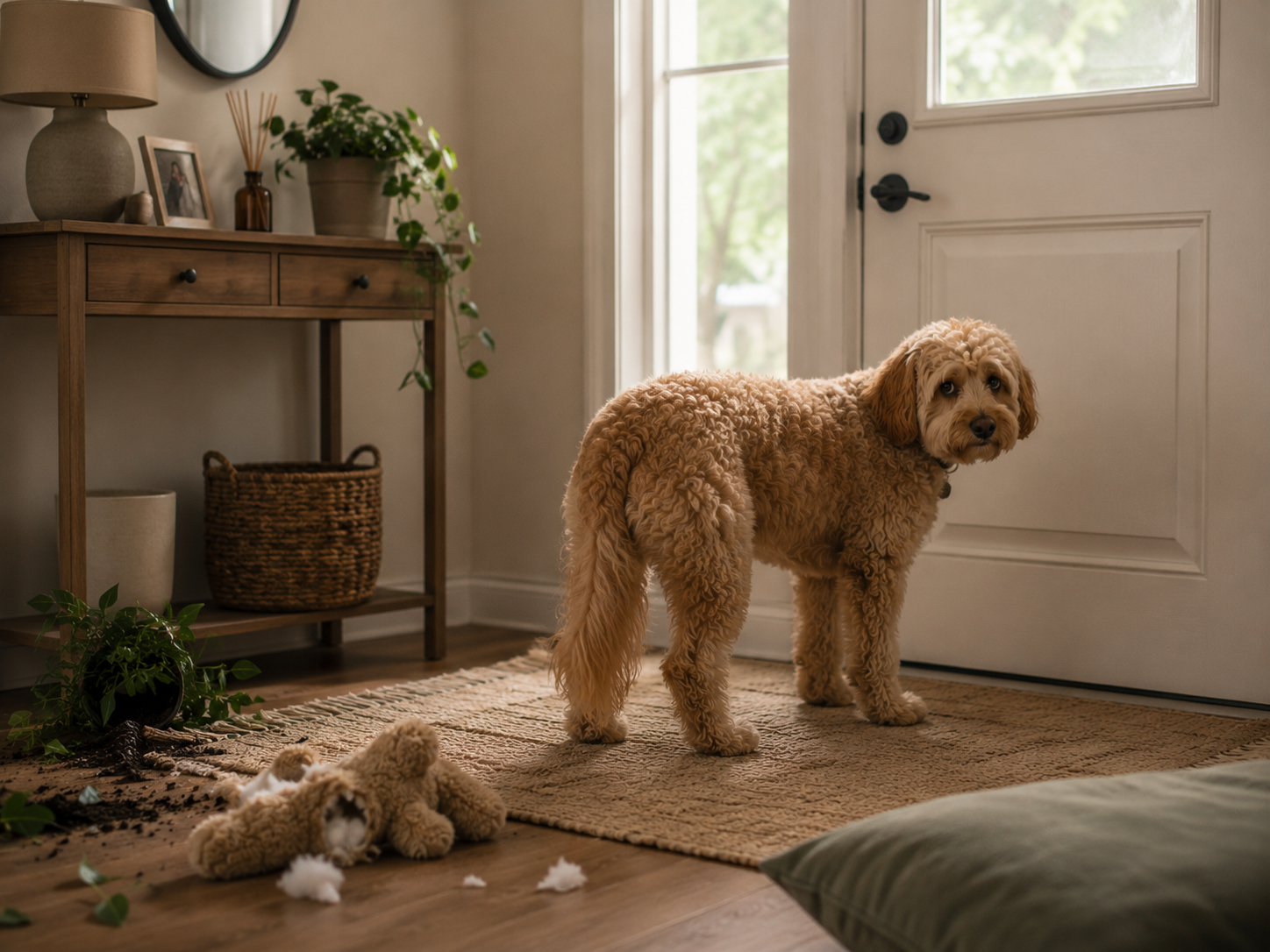
Coming home to find that your dog has peed or pooped while you were away creates a very specific kind of tension, because the problem is not just the behavior itself but the uncertainty behind it. The same outcome can be caused by completely different mechanisms, and those mechanisms require responses that often contradict each other. What makes this difficult is that the situation forces you to act without clarity, and acting without clarity is where most mistakes begin. If the cause is emotional, pressure makes it worse; if the cause is physical, training does nothing; if the cause is incomplete learning, ignoring it delays progress. This is why the behavior feels stuck and unpredictable, even when you are actively trying to solve it. The only way forward is to stop treating the accident as the problem and start understanding it as a signal that reflects what your dog is experiencing in that moment.
Why This Reaction Feels Disproportionately Strong
There is a difference between inconvenience and disruption, and toileting accidents fall into the second category because they challenge something you assumed was already stable. You are not reacting only to the fact that your dog peed or pooped indoors, but to the idea that something that should be predictable is no longer predictable.
This is why the emotional response is stronger than expected.
You start asking questions that go beyond the moment itself. Did something go wrong in training, did I miss something important, is this a sign of a bigger problem, is it going to happen again. The behavior becomes less about the mess and more about the loss of certainty.
And once certainty is gone, every next decision becomes heavier, because you are no longer responding to a known system but to something that feels unstable.
The Problem With Reacting to the Outcome Instead of the Cause
What makes this situation particularly difficult is that the outcome is visible, immediate, and easy to focus on, while the cause is invisible and happens in your absence. This creates a natural but misleading sequence: you see the result, you react to the result, and you assume that reacting to the result will influence what caused it.
But the behavior is not happening in front of you, and the state that produced it is already over by the time you return.
This is where punishment feels logical but fails completely.
Your dog is not making a decision in the moment you are observing. They have already gone through a sequence of events — physical, emotional, or cognitive — that led to the accident, and your reaction is disconnected from that sequence. Instead of creating clarity, it adds uncertainty, especially if anxiety is involved, because now the environment is less predictable both when you are present and when you are not.
The result is not correction. The result is confusion layered on top of whatever caused the behavior in the first place.
Why the Same Behavior Comes From Different Systems
The reason this problem feels so inconsistent is because it is not one problem.
A dog that pees when left alone may be dealing with a physical limitation, a gap in understanding, or a stress response that overrides both control and learning. From the outside, these look identical, but internally they operate on completely different systems.
If the cause is medical, the dog may not have the physical ability to hold, or may experience urgency that cannot be controlled. If the cause is training-related, the dog may not yet understand the boundaries of where and when toileting is appropriate, or may not have built the capacity to wait for longer durations. If the cause is separation anxiety, the dog is not failing to control the behavior but reacting to a level of stress that disrupts normal physiological regulation.
What makes this difficult is that applying the wrong solution does not produce partial improvement. It produces no improvement, or even regression.
And that is why the situation often feels stuck.
What Changes When You See the Full Sequence
The turning point in understanding this behavior is not more effort, but better visibility.
Without seeing what happens when you are gone, your brain fills in the missing information with assumptions, and those assumptions are usually based on what feels most likely, not what is actually happening. A camera removes that gap entirely.
You start seeing timing, and timing immediately changes interpretation. A dog that urinates within minutes of departure while pacing and vocalizing is operating in a completely different state from a dog that rests, wakes up later, and eliminates without visible stress.
The first is a stress-driven response where emotional activation precedes the behavior. The second is a capacity or routine issue where the behavior happens without emotional escalation.
These two situations require different responses, and without seeing the sequence, they are almost impossible to distinguish accurately.
Why Timing Is the Most Reliable Signal You Have
When you step back from the behavior itself and focus on when it happens, patterns begin to emerge that are far more reliable than the outcome.
Early accidents, especially those paired with signs of stress, strongly suggest an emotional trigger. Later accidents, particularly after periods of calm, point toward physical capacity or routine mismatches. Inconsistent timing suggests that additional variables are influencing the situation, such as changes in routine, stress levels, or environment.
This is where tracking becomes critical, not because you need perfect data, but because you need enough consistency to recognize patterns.
Without patterns, everything feels random. With patterns, the situation becomes interpretable.
The Role of the Body in Stress-Related Accidents
One of the most overlooked aspects of this problem is that stress affects the body, not just behavior.
A dog experiencing elevated stress does not simply “choose” to act differently. Their physiological state changes. Muscle tension, hormonal responses, and internal regulation all shift, and in some cases, this can trigger urination or defecation even in dogs that are otherwise fully house-trained.
This is why trying to correct the behavior without addressing the stress behind it rarely works.
You are attempting to control an output that is being driven by a system you are not influencing.
Until that system stabilizes, the behavior will remain unpredictable.
What Actually Helps While You Are Figuring It Out
The instinct to solve the problem quickly often leads to increasing pressure, but pressure without clarity creates more instability.
What works better is reducing variability.
Shorter, more controlled absences reduce the likelihood of repeated accidents while you gather information. Consistent routines around walks, feeding, and rest make patterns easier to identify. Observing rather than reacting allows you to separate emotional responses from physical or training-related ones.
This does not feel like progress, but it is the foundation of it.
Because once the cause becomes clear, the solution is no longer complicated.
When to Remove Uncertainty Completely
There is a point where observation is not enough, and that point is where medical causes need to be ruled out.
If patterns do not align, if accidents happen in multiple contexts, or if physical signs suggest discomfort or urgency, involving a veterinarian is not optional. It is the fastest way to remove an entire category of uncertainty.
Because if the cause is physical, no amount of behavioral adjustment will resolve it.
And if it is not, knowing that allows you to move forward with confidence instead of hesitation.
The Shift That Changes Everything
The difference between feeling stuck and moving forward is not in trying harder.
It is in interpreting correctly.
If you treat the accident as the problem, you will continue reacting to the outcome. If you treat it as a signal, you begin to understand the system behind it.
That shift changes your questions, your decisions, and your expectations.
And once your interpretation is accurate, your actions become effective almost automatically.
Final Thoughts
Your dog is not doing this randomly, and they are not doing it to challenge you.
They are responding to something that is happening inside their body or their environment, and that response is visible in a way that is difficult to ignore.
The difficulty is not in stopping the behavior immediately. It is in understanding it precisely.
Because once you understand it, the situation stops feeling unpredictable.
And when it stops feeling unpredictable, it stops feeling overwhelming.
Log tonight's session from your phone
The Qualma app is available now on Android and iPhone. Sign in with your existing account — no need to subscribe twice.


Continue reading
Veterinary & Behaviorist Advice
My Dog Is Not Taking Revenge: Understanding Why Dogs Pee, Poop, And Destroy Things During Separation Anxiety
Veterinary & Behaviorist Advice
Sudden Separation Anxiety in Senior Dogs: What to Rule Out First
Dog Separation Anxiety