
Dog Separation Anxiety Worse at Night: Why Daytime Progress May Not Transfer
Why is your dog’s separation anxiety worse at night? Learn how time of day, routine, and stress levels affect alone-time tolerance and what to do about it.
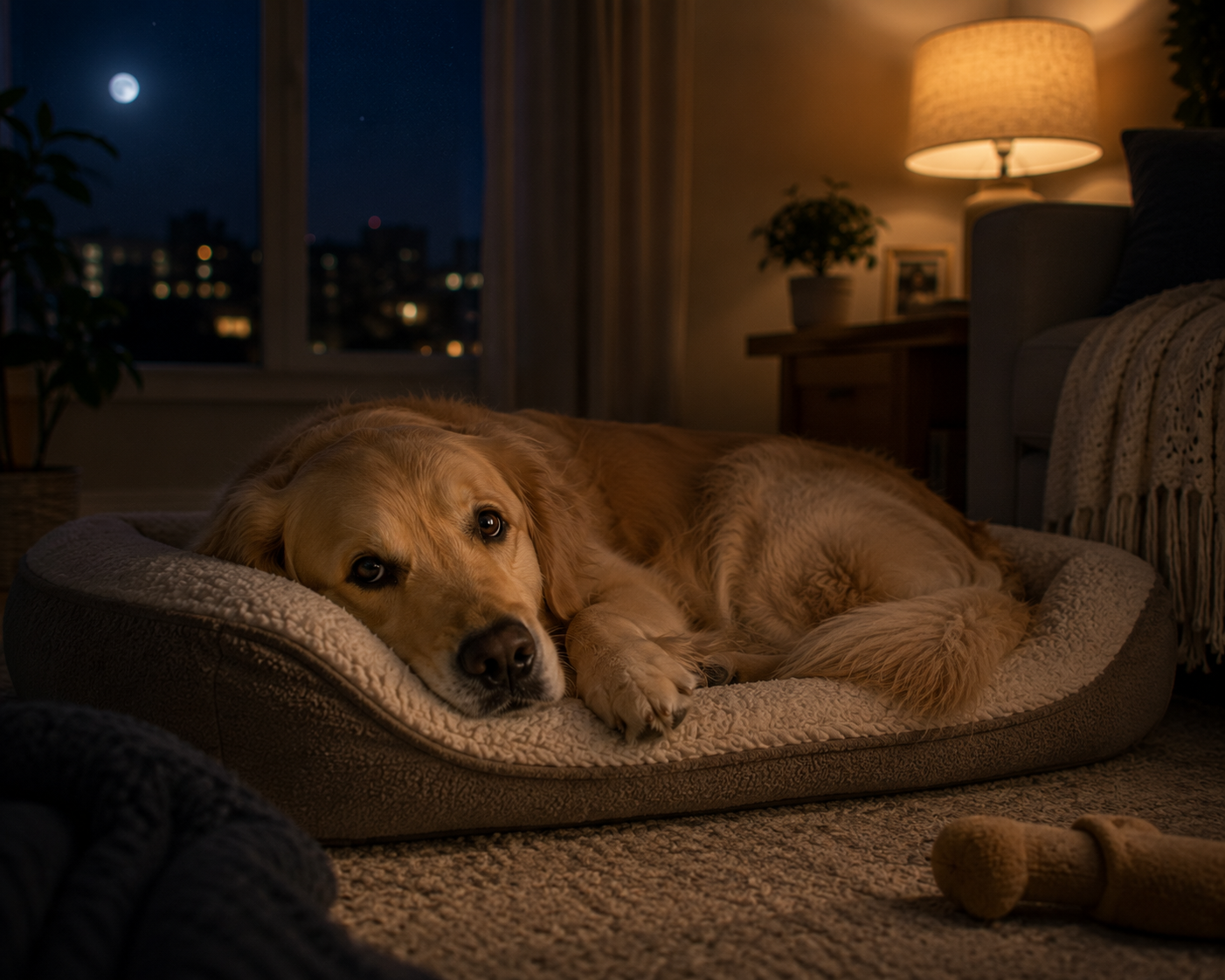
It is one of the most confusing patterns owners notice once they start tracking separation anxiety more closely: the dog can stay alone during the day, sometimes even comfortably, but the same duration in the evening suddenly feels impossible. What looked like progress becomes inconsistent, and it is not immediately clear why. The environment is the same, the training has not changed, and yet the response is different. This creates doubt, because it challenges the assumption that tolerance is a fixed ability rather than a state-dependent one. The reality is that a dog’s ability to cope with being alone is not stable across the day, and evening conditions often introduce a combination of factors that lower that threshold. Understanding how time of day, accumulated stress, routine shifts, and environmental cues interact allows you to see this not as regression, but as a predictable variation. Once you understand that, your approach becomes more precise, and progress becomes more consistent.
When Daytime Success Does Not Repeat in the Evening
The pattern is usually very clear once you start paying attention.
During the day, your dog can stay alone for a certain amount of time without significant stress. They settle, they remain relatively calm, and the absence feels manageable. But in the evening, something shifts. The same duration becomes harder, reactions happen faster, and what felt stable no longer holds.
This creates a disconnect between expectation and experience.
You expect consistency, because the environment appears unchanged. But your dog is not responding to the physical space alone. They are responding to the full context of the moment, and that context is not the same in the evening as it is during the day.
The difference is not in the training.
The difference is in the state your dog is in when that training is tested.
Why a Dog’s Threshold Changes Across the Day
A dog’s ability to cope with being alone is not fixed. It fluctuates depending on internal and external conditions, and one of the most influential variables is time of day.
Throughout the day, your dog experiences multiple inputs—activity, stimulation, rest, interaction, environmental noise—and each of these contributes to their overall level of activation. By the time evening arrives, this accumulation begins to matter.
Even if each individual event seems small, together they create a different baseline.
This is why a dog that is calm alone during the day may become more sensitive in the evening. The threshold has shifted, not because something went wrong, but because the system has been carrying more throughout the day.
The same absence now happens on top of that accumulated state.
The Role of Accumulated Stress
Stress does not reset between events. It builds.
A walk, a visitor, background noise, changes in routine, moments of excitement, or even subtle environmental shifts all contribute to a level of activation that may not be visible in isolation. By evening, your dog is not starting from zero. They are starting from whatever has accumulated.
This is why dogs often appear more reactive or less tolerant later in the day.
It is not about a single trigger. It is about the total load.
And when that load is higher, the margin for additional stress becomes smaller. Being alone, which may be manageable earlier, now pushes the dog beyond their threshold more quickly.
Why Evenings Feel Different to Dogs
Evenings are not just later in the day. They come with their own patterns.
Your behavior changes. The environment changes. The pace of the day shifts. In many homes, evenings are more unpredictable—people move around more, routines are less structured, and departures often happen in a different context than daytime absences.
There is also a difference in expectation.
During the day, your dog may be used to periods of rest or independence. In the evening, the pattern often shifts toward interaction, presence, and shared time. When that expectation is broken by you leaving, the contrast becomes stronger.
This contrast matters more than the duration itself.
The Specific Trigger of “Going Out”
One of the most common variations is the difference between leaving during the day and leaving in the evening for something specific, like dinner.
From your perspective, both are absences. From your dog’s perspective, they are not the same.
Evening departures often involve more cues—getting ready, changing clothes, different movements, different energy. These cues signal something unusual, and unusual signals increase attention.
This is why you may see patterns like a dog that is calm alone daytime but not night, or a dog that panics when owner goes to dinner but tolerates other absences.
It is not just the absence.
It is everything that surrounds it.
Why This Is Not Regression
When evening tolerance is lower, it often feels like progress is disappearing.
But what you are seeing is not regression. It is variation.
Your dog has not lost the ability to cope. They are accessing that ability under different conditions, and those conditions are less stable.
Understanding this prevents a common mistake: trying to push evening absences to match daytime ones.
That approach often fails, because it ignores the difference in baseline state.
Progress is still there.
It just needs to be interpreted correctly.
How to Adjust Without Breaking Progress
The most effective adjustment is not to match the highest achieved duration, but to match the current state.
If your dog handles 40 minutes during the day but struggles at 15 in the evening, the correct starting point is not 40. It is slightly below 15, where the dog can succeed again.
From there, you rebuild within the evening context.
This is important, because it allows your dog to form new associations specific to that time of day. You are not generalizing from daytime success. You are building evening-specific stability.
The difference may feel small, but it changes how progress develops.
Why Tracking by Time of Day Changes Everything
One of the most useful insights comes when you stop treating all absences as equal and start separating them by context.
Tracking daytime and evening sessions separately often reveals patterns that are otherwise invisible. You begin to see that tolerance is not a single number, but a range that depends on conditions.
You also begin to see how recovery works.
A dog may recover quickly after a daytime session but remain more sensitive after an evening one. These differences help you understand how your dog processes stress and how long it takes to return to baseline.
This level of detail allows you to plan instead of react.
What This Means for Training Moving Forward
Once you understand that threshold changes by time of day, your training becomes more precise.
Instead of expecting consistency across all situations, you adapt to the context. You build capacity in each context separately, while maintaining overall stability.
This reduces frustration, because you are no longer comparing mismatched conditions.
It also reduces pressure on your dog, because you are working within their current capacity rather than pushing against it.
Over time, these separate capacities begin to align.
But they do not start aligned.
Final Thoughts
When dog separation anxiety is worse at night, it does not mean something has gone wrong.
It means something has changed.
Your dog is responding to a different combination of factors, and those factors influence how much they can handle in that moment.
The more clearly you see those differences, the easier it becomes to work with them instead of against them.
Because progress is not about forcing consistency.
It is about understanding variability.
And once you understand that, the situation becomes much easier to navigate.
Log tonight's session from your phone
The Qualma app is available now on Android and iPhone. Sign in with your existing account — no need to subscribe twice.