
Dog Wakes Up and Panics When Left Alone: Why Settling Once Is Not the Whole Story
Does your dog settle, then suddenly panic when alone? Learn why waking up can trigger separation anxiety and what it means for your training progress.
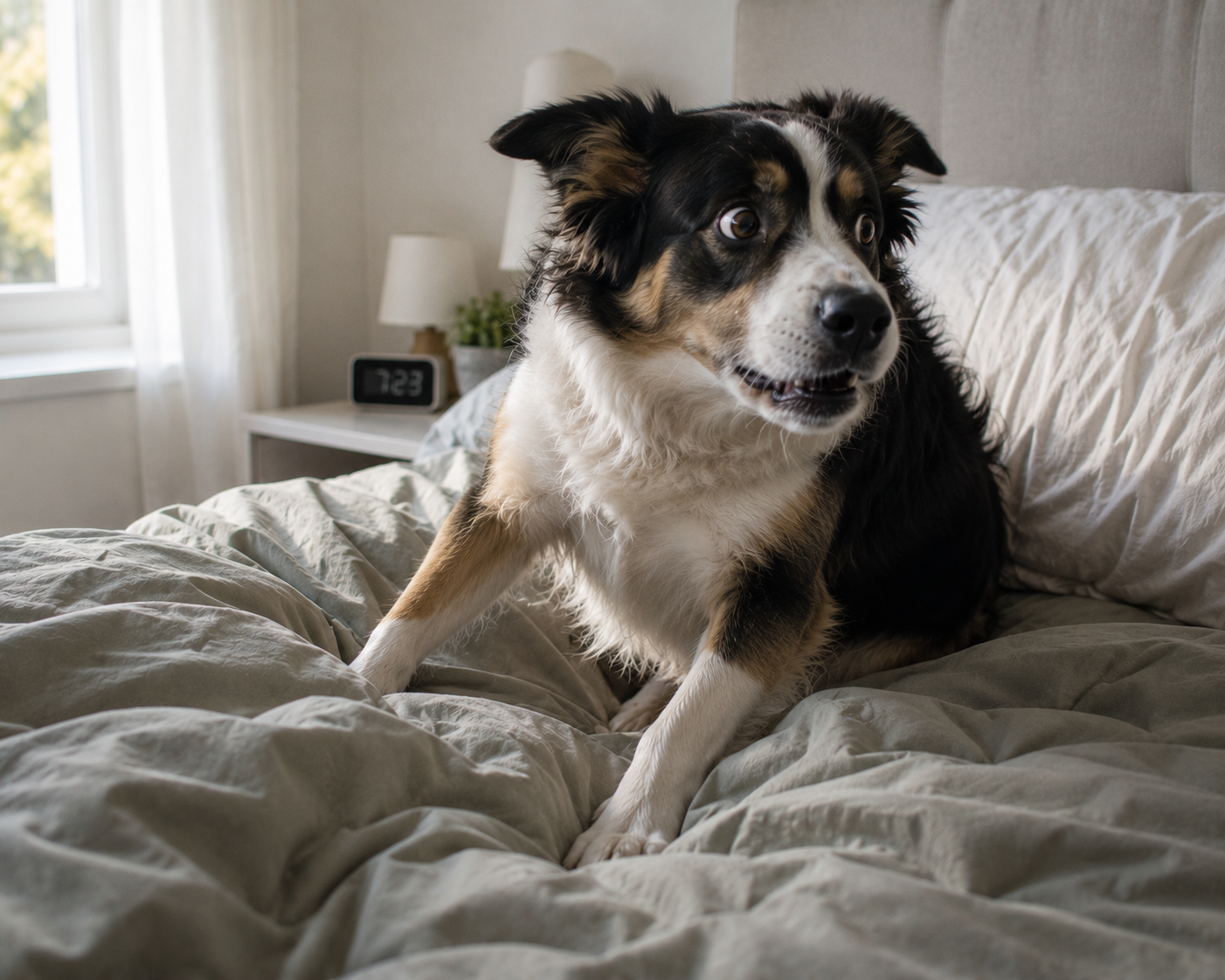
One of the most misleading patterns in separation anxiety appears calm at first: the dog settles after you leave, lies down, and even falls asleep, which seems like a clear sign that the situation is improving. Then, at some point, the dog wakes up and begins to panic, bark, or howl, often more intensely than expected. This creates confusion because the early part of the absence looked successful, leading to the assumption that the dog “can stay alone” for that duration. What is often missed is that settling once is not the same as being able to resettle repeatedly, and the ability to tolerate absence is not defined by the first phase of calm but by what happens after internal states shift. Sleep interrupts awareness, and waking restores it, which means the dog re-evaluates the environment without the buffering effect of initial fatigue or transition. Understanding why this happens requires looking at separation anxiety as a sequence of states rather than a single event. When you focus on how the dog transitions between those states, rather than just whether they were calm at the beginning, the pattern becomes predictable and much easier to interpret.
Why the First Minutes Can Be Misleading
When you observe your dog through a camera and see them settle quickly after you leave, it is natural to interpret that moment as success. The dog is quiet, their body softens, and the environment appears stable. In many cases, this is exactly what training is aiming to achieve.
But this observation captures only the first phase of the absence.
In that phase, several factors are working in your favor. Your dog has just experienced your presence, the transition is recent, and in many cases, physical or mental activity before departure creates a state of temporary fatigue. This combination allows the dog to settle, sometimes quite effectively.
The problem is that this phase does not represent the full experience of being alone.
It represents the moment immediately after transition, not the sustained state of absence.
And in separation anxiety, those are not equivalent.
What Changes When a Dog Wakes Up
Sleep introduces a break in awareness.
While your dog is asleep, they are not actively processing the absence. Their system is disengaged, which temporarily removes the need to cope with being alone. This is why many dogs can appear completely stable for a period of time.
But waking changes everything.
When your dog wakes up, they re-enter the environment with full awareness. They look for cues, reassess their surroundings, and check whether the conditions they expect are present. If you are not there, the absence becomes salient again.
This is the moment where many dogs with separation anxiety struggle.
The initial settling is no longer relevant, because the context has shifted. The dog is now processing absence as a new event, not a continuation of the previous state.
And if they have not learned how to cope with that transition, the reaction begins.
Why Resettling Is Harder Than Settling
There is a fundamental difference between settling once and being able to resettle.
Settling once is often supported by conditions that make it easier: recent interaction, reduced arousal, and a clear transition. Resettling requires something else entirely—the ability to regulate after awareness returns.
This is where separation anxiety becomes more visible.
A dog that can settle but cannot resettle is showing a partial capacity. They can disengage under favorable conditions, but they cannot maintain that state once those conditions change.
This is why patterns such as dog sleeps then barks home alone or dog settles then howls are so common. The initial calm is not false, but it is incomplete.
And because it is incomplete, it does not extend across the entire duration of the absence.
The Role of Internal State Transitions
To understand this behavior properly, it helps to think in terms of state transitions rather than time.
Your dog moves between states: active, resting, sleeping, waking, alert. Each transition changes how they process the environment. Separation anxiety is not triggered only by the act of leaving, but by how the dog interprets the environment at each of these points.
The waking moment is particularly sensitive because it combines awareness with uncertainty.
The dog becomes aware of the environment, checks for expected cues, and finds that something is missing. That gap between expectation and reality is what triggers the reaction.
This is why separation anxiety after waking can feel more intense than the initial response. It is not buffered by transition or fatigue. It is immediate and fully processed.
Why Duration Alone Does Not Define Progress
Many owners track progress in terms of how long the dog can stay alone, but this pattern shows why duration can be misleading.
If a dog remains calm for thirty minutes and then panics, it is tempting to say that their threshold is thirty minutes. But in reality, the threshold is not tied to time—it is tied to state.
The dog did not tolerate thirty minutes of being alone. They tolerated the period until the next state change occurred.
This distinction matters because it changes how you approach training.
Instead of asking how long the dog can stay alone, you begin asking whether they can remain regulated across different states, including waking and re-engagement with the environment.
What Cameras Reveal That You Cannot Infer
Without a camera, this pattern is almost impossible to detect.
You would leave, return, and see no obvious signs of distress, especially if the reaction occurs later and resolves before you come back. The assumption would be that everything went well.
With a camera, the sequence becomes visible.
You see the initial settling, the period of sleep, the waking moment, and the reaction that follows. You see whether the dog attempts to resettle or escalates immediately. You see whether the reaction is brief or sustained.
These details transform your understanding of what is happening.
They show you that the problem is not the absence itself, but the transition within it.
How to Approach Training When This Pattern Appears
Once you understand that the difficulty lies in resettling, the approach needs to shift accordingly.
Training should focus not only on initial departures but on stability across time and state changes. This often means working at durations that allow the dog to experience waking and remain calm, even if those durations are shorter than what was previously attempted.
The goal is not to extend time immediately.
The goal is to create experiences where waking does not trigger distress.
This may feel like a step back, but it is actually a refinement. You are not reducing progress—you are making it more robust.
Why Puppies Show This Pattern Early
This pattern is particularly common in puppies, especially those that wake up crying when the owner is gone.
Puppies cycle through sleep more frequently, and their ability to regulate after waking is still developing. Each waking moment is a new opportunity to reassess the environment, and without established coping mechanisms, that reassessment often leads to vocalization.
What looks like inconsistency is actually developmental.
Understanding this prevents misinterpretation and allows for a more appropriate training approach.
Final Thoughts
A dog that wakes up and panics when left alone is not contradicting earlier progress.
They are showing you the limits of that progress.
Settling once is not the same as staying calm, and staying calm is not defined by silence alone. It is defined by the ability to move through different states without escalating into distress.
When you shift your focus from time to transitions, the behavior becomes easier to understand and easier to address.
Because in separation anxiety, the critical moment is not always when you leave.
It is when your dog wakes up and realizes that you are still gone.
Log tonight's session from your phone
The Qualma app is available now on Android and iPhone. Sign in with your existing account — no need to subscribe twice.