
I Need Enrichment That Is Affordable and Possible in a Small Apartment
Looking for affordable enrichment for an anxious or reactive dog in a small apartment? Discover simple scentwork and calm indoor activities that actually help.
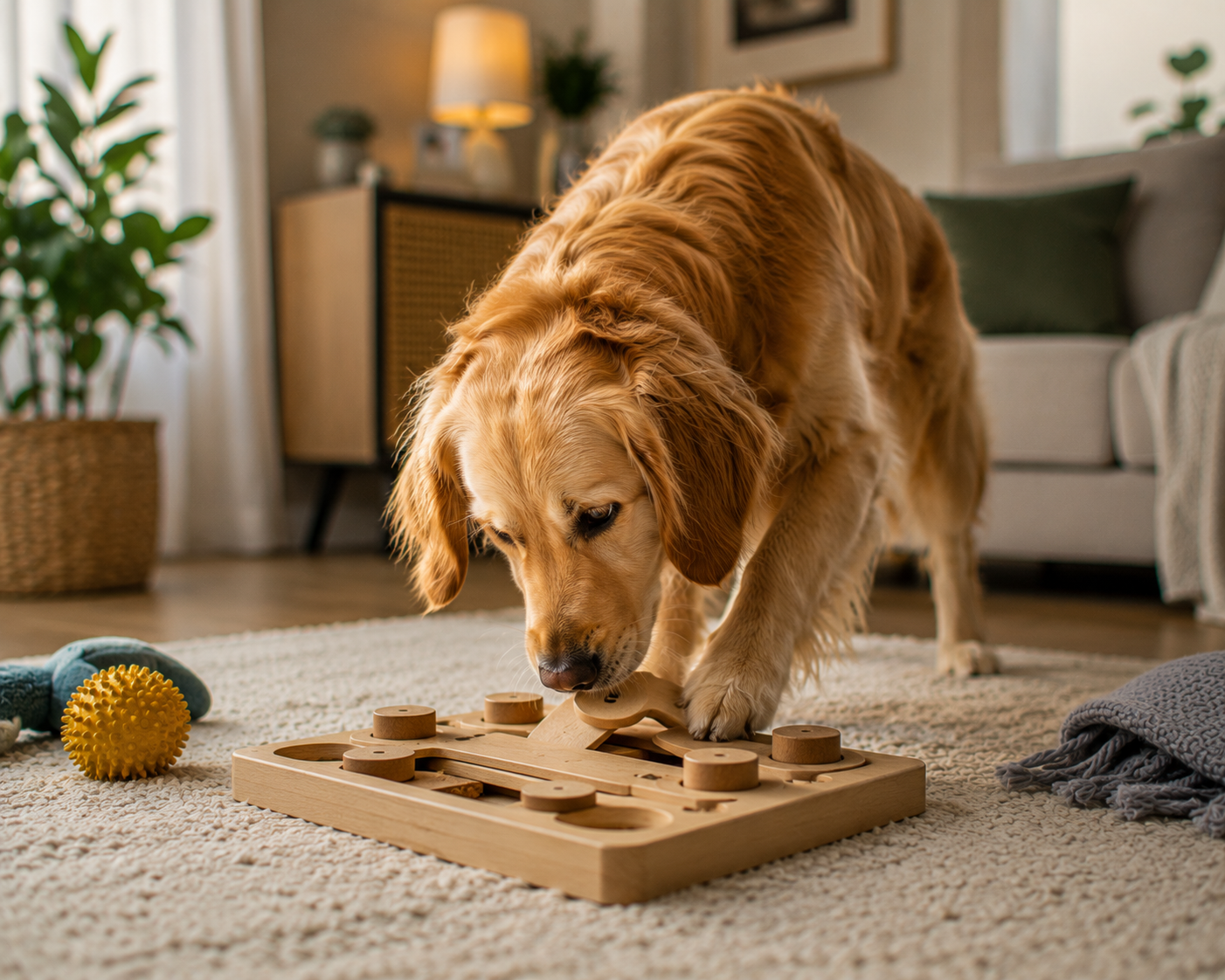
There is a specific kind of frustration that appears when you are trying to do the right thing for your dog and everything you read seems designed for a different reality. Advice about enrichment often assumes access to space, money, time, and a dog that is comfortable in social environments, when in reality many owners are working with anxious or reactive dogs in small apartments with limited options. This creates a gap between what is recommended and what is actually possible, and that gap quickly turns into pressure, because you know your dog needs stimulation, but the available solutions feel either inaccessible or inappropriate. The difficulty is not a lack of effort, but a mismatch between the dog’s needs and the environment they live in. What is often missed is that effective enrichment does not depend on complexity, cost, or social interaction, but on whether the activity aligns with how the dog naturally engages with the world. When you shift from trying to replicate ideal conditions to building workable ones, enrichment becomes simpler, more consistent, and far more effective. This is where indoor scentwork, low-cost games, and calm, structured activities become not just alternatives, but the most relevant tools for dogs that cannot rely on external environments.
When Enrichment Advice Stops Making Sense
At some point, most owners of anxious or reactive dogs realize that mainstream enrichment advice was not written for them. Dog parks, group classes, long social walks and agility courses all assume a dog who can tolerate noise, unpredictability and interaction without becoming overwhelmed. For a fearful or reactive dog those environments do not provide enrichment at all; they provide stress with an enrichment label attached.
That leaves you in a quiet contradiction. You are told your dog needs stimulation, while every available way of providing it is precisely the situation that triggers the problem. Over months this settles into a persistent sense of doing either too little or the wrong thing, even when you are adapting constantly.
Apartment enrichment for reactive dogs matters because it reframes the question rather than answering it. The goal was never to recreate ideal conditions, which you cannot do and which would not suit your dog anyway. It is to build conditions your dog can actually use, which is both a smaller task and a more achievable one.
Why Small Spaces Are Not the Limitation You Think They Are
A small apartment feels like a constraint, and in several ways it is quietly an advantage. A controlled space removes variables: no unexpected dogs, no sudden interactions, no environmental triggers you cannot influence. What remains is somewhere your dog can engage with an activity without managing stress at the same time, which is exactly the condition most enrichment advice fails to provide.
This matters most if your dog cannot yet cope with other dogs, because it lets you focus entirely on the activity rather than on the environment around it. What determines whether enrichment works is not how much space you have but how predictably you use it. A structured, familiar room can produce more meaningful engagement than a large uncontrolled one.
Why Scentwork Changes Everything
Scentwork is often described as a game, but it is more accurate to think of it as a system that aligns with how dogs naturally process the world.
Dogs do not need to be taught how to use their nose. They need to be given opportunities to use it in a way that feels safe and rewarding. When a dog engages in scentwork, they are not just searching for food. They are solving a problem in a way that is instinctively satisfying.
The effect on their emotional state is the whole point. Searching slows a dog down, gives them a single clear task, and reduces the constant environmental monitoring that anxious dogs do by default. Those three things happen together, which is why the activity settles a dog rather than winding them up.
For an anxious dog that shift is the difference between reacting to whatever happens around them and working on something they have chosen to focus on. Indoor scentwork for anxious dogs is often more effective than more active forms of enrichment for exactly that reason: it meets the dog where they already are, rather than asking them to cope first and enjoy it afterwards.
Why Cheap Enrichment Often Works Better
There is a strong assumption that better enrichment requires better equipment — more toys, more gadgets, more structured activities. In practice the opposite is usually true, because cheap enrichment for anxious dogs works precisely by removing complexity. A handful of treats scattered on the floor, a towel with food rolled inside, or a simple nosework game for a rescue dog often produces more engagement than an expensive puzzle the dog cannot interpret.
The effectiveness comes from clarity rather than cost. A task that is simple and repeatable lets your dog succeed quickly, that success becomes a pattern, and the pattern is what builds confidence. Complexity can come later once the game itself is understood, but it is never where the process should begin.
What Scent Games Actually Look Like in Practice
Scent games do not need to be complicated to work. In the first sessions the aim is to engage your dog rather than challenge them, so scatter five or six pieces of food in a small area in plain sight and let them search without any pressure. Over the following weeks the search can expand: food hidden under objects, rolled inside fabric, or placed in a second room once the first has become easy.
What matters is not how difficult the game is but how reliably your dog can finish it. A task that tips into frustration loses the benefit entirely, while one that stays achievable keeps them engaged and regulated. If your dog wanders off partway through, the search was simply harder than they were ready for, and the next one should be easier rather than more interesting.
This is where scent games for reactive dogs differ from most other activities. Rather than asking your dog to cope with something slightly beyond what they can manage, they work entirely inside that limit. Nothing about the game requires your dog to tolerate anything, which is why it can be repeated daily without accumulating stress.
Why Trick Training Works Differently for Anxious Dogs
Trick training is often seen as something separate from enrichment, but for anxious dogs it can serve a similar function.
It provides structure, repetition, and a clear feedback loop. The dog performs a behavior, receives a reward, and repeats the process. This predictability reduces uncertainty and builds a sense of control.
What matters is not the complexity of the trick, but the clarity of the interaction.
Simple behaviors, repeated consistently, create a rhythm that supports calmness. Over time, this rhythm becomes familiar, and familiarity reduces stress.
In this way, trick training becomes less about learning commands and more about building stability.
Why You Don’t Need to “Replace” Outdoor Activity
There is a persistent worry that indoor activities are not enough, and that without long walks, social contact and outside stimulation a dog is missing something essential. For a confident dog that concern is often fair. For a fearful or reactive one it usually points at the wrong problem: the difficulty is rarely too little stimulation, but too much of a kind your dog cannot process.
Indoor enrichment does not need to replace outdoor activity entirely. It needs to provide a form of engagement that the dog can process without becoming overwhelmed. When that balance is achieved, even limited outdoor exposure becomes more manageable.
Because the dog is no longer operating at maximum stress.
How Consistency Changes Everything
The effect of enrichment comes from repetition rather than from any single session. When scentwork and other calm activities become part of the daily routine, your dog starts to expect them, and that expectation reduces uncertainty in a way that lowers baseline stress. Over weeks they also become more practiced at shifting into a settled state, which is a skill rather than a mood.
This is where calm indoor activities for fearful dogs produce lasting change. It arrives through consistency rather than intensity, which is why three short sessions a week across a month do more than one ambitious afternoon.
Why This Approach Feels Different
What makes this kind of enrichment effective is not what it adds but what it takes away. It removes the pressure to perform, the unpredictability of an uncontrolled environment, and the need for your dog to keep monitoring what might happen next. In place of those it offers clarity, repetition and success, which are the conditions under which a dog can actually learn something.
For a dog who struggles with the outside world, this is often the first setting where they can engage fully without also protecting themselves. That engagement is where progress starts, and it is the reason a modest indoor routine can matter more than an ambitious outdoor one.
Final Thoughts
If you are working with an anxious or reactive dog in a small apartment, the limitation is not the space but the assumption that enrichment has to look a particular way. Once that assumption goes, the options become both simpler and more effective. Scentwork, low-cost games and structured indoor activities are not second-best substitutes for something better.
For this kind of dog they are frequently the most relevant tools available, because they let your dog do what they are built to do somewhere that feels safe. For many dogs that is the first step toward everything else becoming easier.
Log tonight's session from your phone
The Qualma app is available now on Android and iPhone. Sign in with your existing account — no need to subscribe twice.