
My Dog Falls Asleep, Wakes Up, and Immediately Panics Again
Does your dog fall asleep, then wake up and panic when left alone? Learn why settling once is not enough and how to interpret this common separation anxiety pattern.
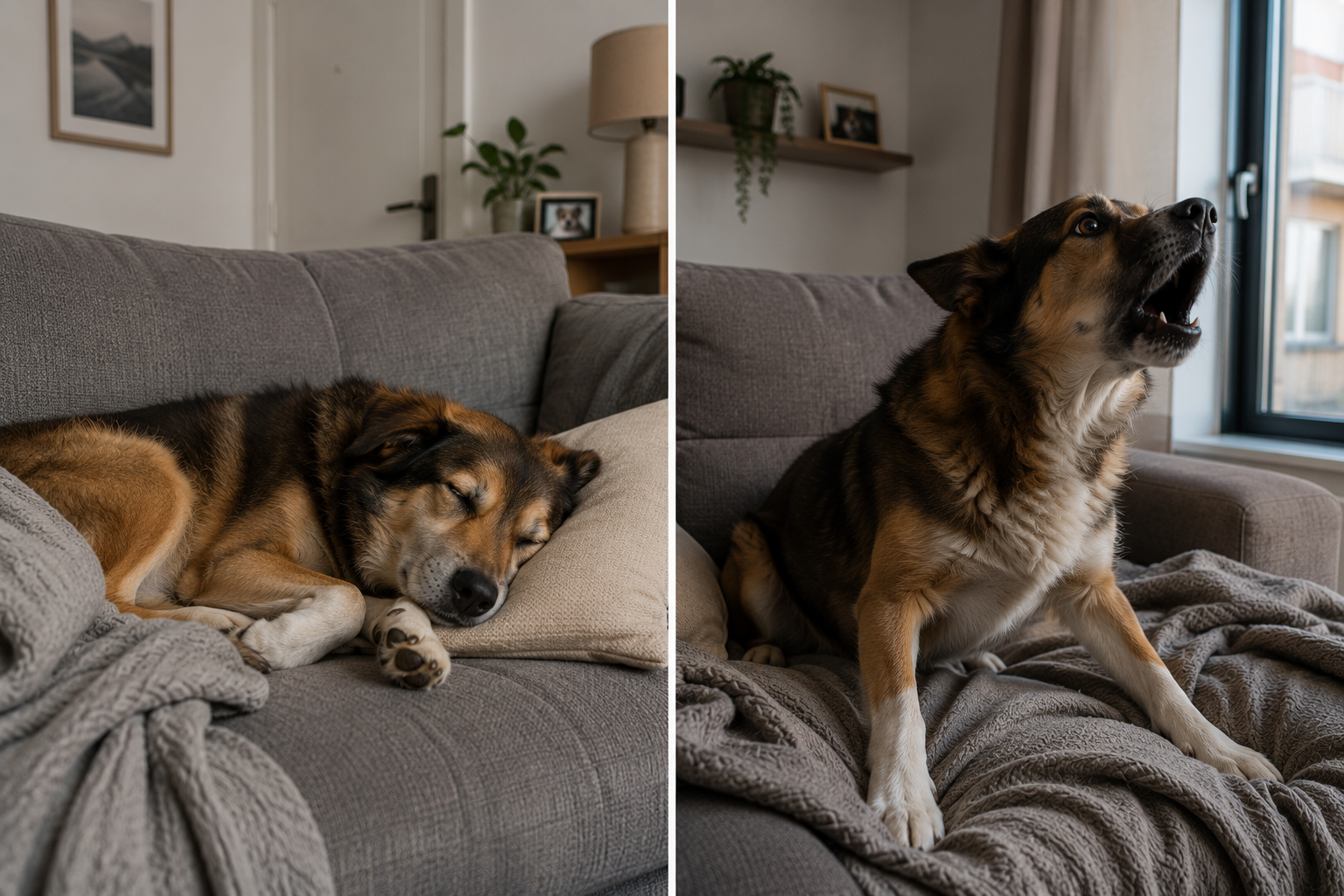
There is a pattern in separation anxiety that is easy to miss precisely because it begins with something that looks like success. The dog settles, lies down, and eventually falls asleep, which creates the impression that the absence is being handled well. Many owners stop evaluating at this point, because the initial response appears calm and stable. But when the dog wakes up and immediately begins to bark, howl, or panic, the interpretation shifts from confidence to confusion. What looked like progress now feels unreliable, and the question becomes whether the dog can actually cope with being alone at all. The difficulty is that this behaviour is not inconsistent; it is structured, and it follows a sequence of internal state changes that are rarely observed in full. Understanding this sequence—rather than focusing on a single moment—reveals that settling once is not the same as being able to remain settled. When you start looking at the absence as a series of emotional phases instead of a single block of time, the pattern becomes predictable, and the next steps become clearer.
Why the First Part of the Absence Looks Like Success
The beginning of an absence often contains conditions that make calmness easier.
Your dog has just experienced your presence, which reduces uncertainty. There may have been activity before you left, which lowers arousal through physical or mental fatigue. The transition from interaction to absence is still recent, and the environment has not yet been fully re-evaluated.
These factors create a window in which settling is likely.
The dog lies down, disengages from the immediate environment, and may fall asleep. From the outside, this looks like the desired outcome of separation anxiety training. The dog is quiet, still, and not visibly distressed.
But this moment does not represent the whole absence, only its first phase. What happens next — when your dog wakes and reassesses the situation — is a separate event with a different emotional starting point, and it is usually the part nobody watches.
What Changes When the Dog Wakes Up
Sleep interrupts awareness.
While your dog is asleep, they are not actively processing the environment. The absence is not being evaluated, and the need to cope with it is temporarily suspended. This is why dogs that struggle with separation can still fall asleep early in an absence.
Waking reverses that state.
The dog becomes aware again, and the first thing they do is re-evaluate the environment. They look for expected cues, and one of those cues is your presence. When that presence is not there, the absence becomes salient again.
This is the moment where many dogs shift from calm to distress.
The reaction is not delayed. It is immediate, because it is tied to awareness, not to time.
Why Settling Once Is Not Enough
The ability to settle at the beginning of an absence is often read as the ability to stay alone, but these are different capacities that simply look alike from outside the door. One is about getting into a calm state; the other is about staying there through changes you cannot see.
Settling once depends on favorable conditions—recent interaction, reduced arousal, and a clear transition. Remaining settled requires the ability to move through multiple internal states without escalating into stress.
This includes waking.
A dog that can fall asleep but cannot resettle after waking is showing a partial ability, not a complete one. The initial calm is real, but it does not extend across the full duration of the absence.
This is why patterns like a dog who sleeps at first and then howls, or settles and then panics, appear so frequently. They are not contradictions to be explained away, and they are not evidence that the training has failed. They are incomplete regulation: real progress that stops short of covering the whole absence.
The Sequence That Most Owners Never See
When you look at the full absence through a camera, the behaviour becomes structured rather than random.
There is usually a departure response, even if it is mild. This is followed by an initial settling phase, where the dog disengages from the environment. Then comes the first sleep period, which creates the appearance of stability.
After that, the critical transition occurs.
The dog wakes, checks the environment, and responds to what they find. This may lead to renewed distress, or, in more stable cases, a second settling phase. Environmental sounds may influence this transition, either triggering or interrupting it.
Finally there is the reunion and the recovery that follows it. Each of these phases tells you something different about how your dog is coping, and none of them can be inferred from the others. If you stop watching once your dog falls asleep, you miss the phase that matters most.
Why Dogs Cannot Resettle Easily
Resettling requires a different skill than settling.
When a dog settles initially, they are moving away from an active state into rest. When they wake, they are moving from rest into awareness, and then attempting to return to rest again without the original conditions that made it easy.
This is significantly more difficult.
The dog is now fully aware that you are absent, and that awareness creates uncertainty. If they do not have a learned response to that uncertainty, the default reaction is to escalate.
This is why you see patterns like a dog who cannot resettle alone, or a puppy who wakes and cries once the house has gone quiet. The difficulty is not falling asleep, which most dogs manage easily enough at the start of an absence. It is returning to calm after waking, which is a skill they have not yet been taught.
Why Food and Toys Stop Working
Many owners try to support the absence with food toys, chews, or enrichment.
These can be effective during the initial phase, when the dog is still engaged and the emotional state is manageable. But once the dog wakes and becomes aware of the absence, these tools often lose their effectiveness.
This is not because your dog has lost interest in the food itself. It is because their emotional state has changed, and a stressed dog is simply not in a condition where eating feels relevant.
Stress reduces the ability to engage with food. The dog is no longer in a state where exploration or consumption feels relevant. Their focus shifts to the absence itself, and everything else becomes secondary.
This is why enrichment cannot solve separation anxiety after waking. It works on occupation rather than on regulation, which means it can support a dog who is already coping but cannot rescue one who is not.
Why This Pattern Feels So Inconsistent
From the outside, this behaviour looks unpredictable.
The dog appears calm, then suddenly reacts. There is no obvious trigger, no clear escalation, just a shift from one state to another.
The pattern is entirely consistent once you look at it as a change in internal state rather than a reaction to something in the room. The transition from sleep to full awareness is the trigger, and it happens on your dog's schedule rather than the environment's. Recognizing that makes the behavior far easier to interpret: it is not random at all, but timed to a specific moment in your dog's experience that you cannot see from outside.
How This Changes Your Training Approach
If you judge progress only by the initial settling, you will overestimate how long your dog can actually cope and push duration further and faster than they are ready for. That reinforces the waking reaction rather than reducing it, which is why some dogs appear to get worse the harder their owners work.
A more effective approach is to keep absences within a length that lets your dog wake and recover without escalating. In practice that often means noticeably shorter absences than you expected, but far more stable ones. The aim for now is not to extend the time at all — it is to build successful transitions between states, because that is the capacity every longer absence will eventually rest on.
Why Tracking Phases Matters More Than Tracking Time
Tracking only duration tells you how long your dog was alone, which is the one number that hides the structure of what happened. Tracking phases instead — settling, sleeping, waking, and whatever follows — shows you where the difficulty actually sits, and therefore what to work on next.
How long does it take for your dog to settle? How long before they fall asleep? When do they wake? What happens in the moments after waking? Do they attempt to resettle, or escalate immediately?
Those details are what reveal the pattern, and they take only a few lines to note after each absence. Once the pattern is clear, decisions about duration stop being guesses and start being informed by what your dog actually does.
Final Thoughts
A dog who falls asleep and then panics on waking is not failing to cope. They are showing you precisely where their current capacity ends, which is more useful information than an absence that goes uniformly badly. Settling once and remaining calm are different achievements, and the second depends on being able to move between states without losing regulation.
Once you shift your attention from silence to transitions, the behavior stops looking contradictory. The most important moment in separation anxiety is often not the one when you leave. It is the one when your dog wakes up and realizes you are still gone.
Log tonight's session from your phone
The Qualma app is available now on Android and iPhone. Sign in with your existing account — no need to subscribe twice.