
My Rescue Dog Can Handle One Hour One Day and Only Ten Minutes Another Day
Why can your rescue dog stay alone for an hour one day but panic after ten minutes the next? Learn how to interpret early behavior and assess alone-time correctly.
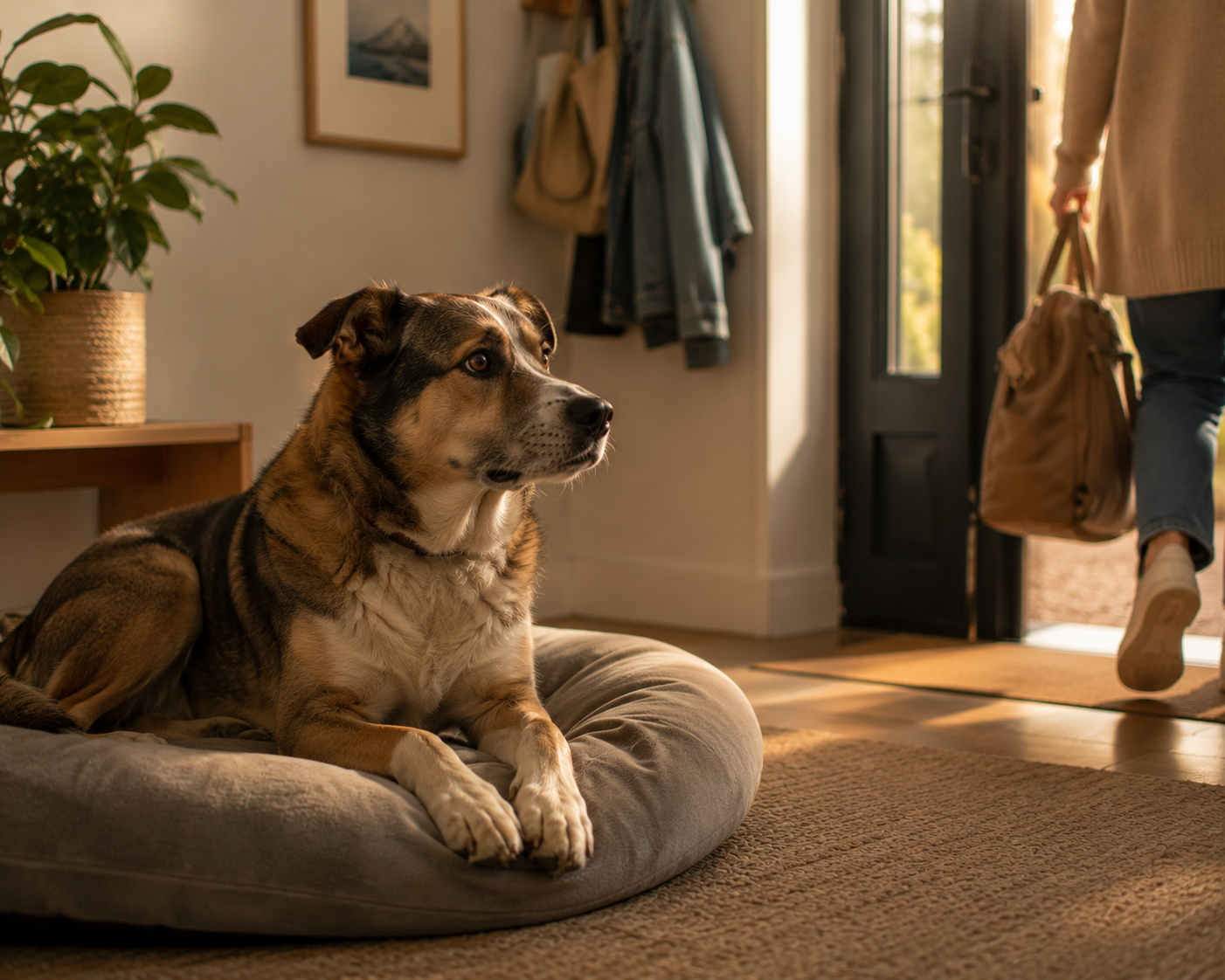
One of the most confusing patterns new rescue dog owners encounter is not consistent difficulty, but inconsistency itself. A dog that panics after a short absence one day may appear completely settled during a much longer absence the next, creating a situation where no clear threshold seems to exist. This variability often appears early after adoption, when the dog is still adjusting, and it leads to a natural question: when does it make sense to assess what the dog can actually handle? The difficulty is that early behaviour is not stable, even when it looks calm, and testing thresholds during this period can produce misleading or even counterproductive results. A single successful absence does not define capacity, just as a single reaction does not define a problem. Understanding this requires shifting away from the idea of a fixed number and toward a framework that considers context, internal state, and the conditions surrounding each absence. When you observe patterns instead of isolated outcomes, the apparent inconsistency becomes structured, and the decision of when and how to assess alone-time becomes much clearer.
When Inconsistency Feels Like a Problem in Itself
There is a particular kind of tension that comes from not being able to predict your dog’s response.
If your dog struggled every time you left, the situation would be difficult but clear. If your dog was always calm, the situation would be simple. But when one day they can stay alone for an hour and the next day they panic after ten minutes, the uncertainty becomes the main challenge.
You start looking for explanations in each individual event.
Why did it work that time? What was different? Did I do something wrong the other day? Was it the walk, the time of day, the environment, or something I didn’t notice at all?
This line of thinking is natural, but it often leads to the wrong conclusion.
Because the inconsistency is not random.
It is the result of a system that has not stabilized yet.
Why Early Behaviour Is Not Reliable Data
In the first weeks after adoption, your dog is not operating from a consistent baseline.
Even if their behaviour appears calm, their internal state is still adjusting to a new environment. They are processing new routines, new sensory input, and a completely different structure of daily life. This process does not happen all at once, and it does not move in a straight line.
This is why early observations can be misleading.
A dog that sleeps through a one-hour absence after a long walk may not be demonstrating a true ability to stay alone. They may simply be physically exhausted. A dog that reacts strongly to a short absence may not be showing their long-term capacity, but rather responding to a moment of heightened sensitivity.
Both observations are valid.
But neither defines the threshold.
Why One “Successful” Absence Doesn’t Mean Stability
It is very tempting to anchor your expectations to the longest successful absence.
If your dog stayed alone for an hour without visible distress, it feels like a milestone. It creates a reference point, something you can aim to repeat.
But this is where interpretation becomes critical.
The question is not whether your dog was quiet for an hour.
The question is what state they were in during that hour.
Were they relaxed, shifting between rest and light sleep, or were they simply inactive due to fatigue? Did they wake and resettle, or did they remain in one state the entire time? Did they respond to small environmental changes, or were they disengaged?
Without this context, duration becomes misleading.
Because duration without stability does not translate into repeatability.
Why Short Reactions Matter More Than Long Successes
A ten-minute reaction often tells you more than a one-hour calm period.
When your dog reacts quickly after you leave, especially in a way that is linked to specific cues like picking up keys or stepping outside, you are seeing a direct response to absence. This response is less influenced by fatigue, routine, or accumulated conditions.
It is a clearer signal.
This does not mean that the dog cannot eventually stay alone longer. It means that, in that moment, the system is not stable enough to support longer durations consistently.
This is why early training should focus more on repeatable calm experiences than on maximum duration.
The Role of Context in Every Observation
What often looks like inconsistency becomes structured when you consider context.
Time of day matters. A dog may handle absence differently in the morning than in the evening due to accumulated stress. Environment matters. A quiet apartment is different from a building with constant noise. Pre-departure activity matters. A long walk changes the dog’s state in a way that affects their response.
Even small details can shift the outcome.
The same dog, the same duration, but under slightly different conditions can produce completely different results.
This is why comparing absences without aligning context leads to confusion.
You are not comparing the same situation.
Why You Should Not “Test” the Threshold Directly
The instinct to find the limit is strong.
You want to know how long your dog can stay alone, and the fastest way to find that out seems to be testing it directly. You increase duration until the dog reacts, and then you assume that the point just before that reaction is the threshold.
The problem is that this approach creates the very stress you are trying to avoid.
A long panic episode does not just reveal a limit. It reinforces the association between being alone and feeling unsafe. It adds a data point that is costly to recover from.
This is why testing in this way is rarely useful, especially in the early stages.
It gives you an answer, but it changes the system at the same time.
What to Do Instead: Observing Before Defining
A more accurate approach is to delay defining a threshold and focus on collecting observations.
You allow multiple short absences under controlled conditions. You vary only one factor at a time. You observe how your dog responds not just in terms of duration, but in terms of state.
Over time, patterns emerge.
You begin to see which conditions support calmness and which increase sensitivity. You see how quickly your dog settles, how they respond to waking, and how they recover after you return.
At this point, the idea of a threshold becomes less about a number and more about a range.
And that range is far more reliable.
How Tracking Changes Your Understanding
Without tracking, early behaviour feels chaotic.
With tracking, it becomes structured.
You start to connect specific responses to specific conditions. You see that a longer absence after a walk does not necessarily mean higher tolerance. You notice that reactions happen faster in certain contexts, and that recovery varies depending on what came before.
This is where tools like Qualma become valuable.
They allow you to record not just what happened, but the conditions under which it happened. Over time, this creates a map of your dog’s responses, and that map is what allows you to make accurate decisions.
When It Becomes Meaningful to Assess a Threshold
A threshold becomes meaningful only when the system is stable enough to produce consistent responses.
This does not mean your dog never reacts. It means that under similar conditions, their response is predictable. The same duration produces similar outcomes, and variations can be explained by identifiable factors.
At this point, increasing duration becomes a controlled progression rather than an experiment.
Before that point, defining a threshold is premature.
Final Thoughts
If your rescue dog can handle one hour one day and only ten minutes another, the inconsistency is not the problem.
It is the information.
It tells you that the system is still adjusting, that context matters, and that capacity is not yet stable.
The goal is not to eliminate that variability immediately.
The goal is to understand it.
Because once you understand it, the question of “how long can my dog stay alone” becomes much less important than “under what conditions does my dog feel safe.”
And that is the question that leads to real progress.
Log tonight's session from your phone
The Qualma app is available now on Android and iPhone. Sign in with your existing account — no need to subscribe twice.