
How to Prevent Separation Anxiety When You Work From Home With a Puppy or New Dog
Working from home with a puppy or new dog? Learn how constant presence can lead to separation anxiety—and how to build independence early without harming your bond.
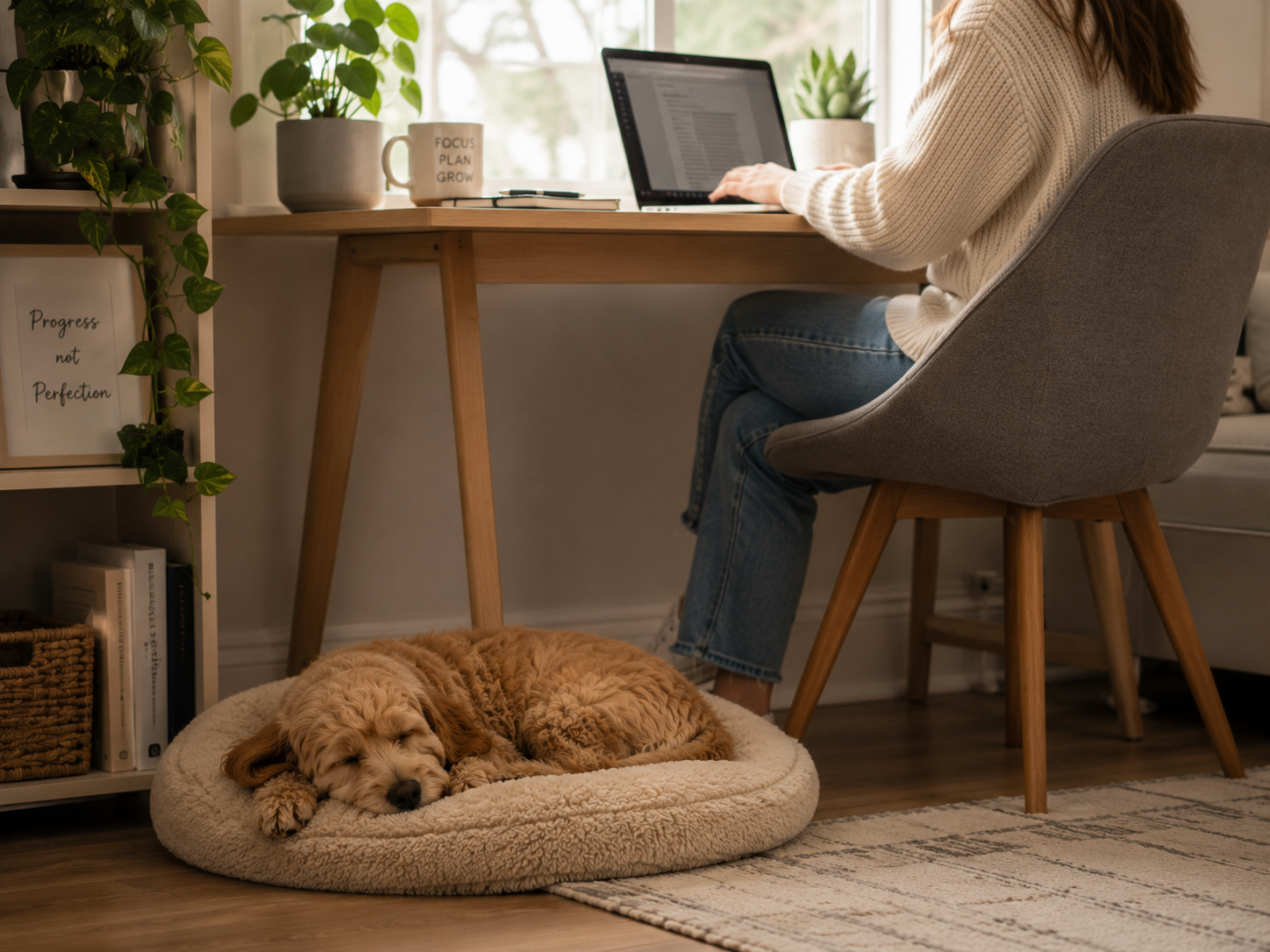
Working from home feels like an advantage when you bring a puppy or a new dog into your life. You are there to support them, to build a bond, to make sure they settle in safely and comfortably. But what often goes unnoticed is how easily constant presence can become constant dependence. Days pass without your dog ever truly experiencing separation, and what feels like care and attentiveness slowly turns into a pattern where being alone simply does not exist in their world. The difficulty appears later, often unexpectedly, when you leave the room for the first time and your dog reacts with confusion or distress. This is not because you did something wrong, but because something important was missing from the routine: small, manageable experiences of independence. Preventing separation anxiety while working from home is not about creating distance, but about building comfort with it early, gently, and consistently. When you understand how these patterns form, you can shape them before they become a problem.
When Being Home All Day Starts Working Against You
There is a quiet trap in working from home, and it does not look like a problem at first. Your dog follows you from room to room, settles next to your desk, watches you move through the day. It feels natural, even comforting. You are building a relationship, and everything seems stable.
But what is actually forming underneath is a very consistent pattern: you are always there.
Your dog learns this without effort. They do not question it, they do not analyze it, they simply experience it as the way the world works. Wherever they go, you are nearby. Whatever happens, your presence is constant.
And because nothing challenges that pattern, nothing interrupts it, there is no opportunity to learn what happens when you are not there.
This is where the problem begins — not in what you are doing, but in what is missing.
Why This Is Not Your Fault
It is important to say this clearly, because many owners feel guilt when they realize what has happened.
You did not create separation anxiety by being present. You created safety, connection, and stability. Those are not mistakes.
The issue is not presence. It is the absence of gradual independence within that presence.
Dogs do not automatically learn how to be alone just because they feel secure with you. In fact, strong attachment without independent experiences can make separation more difficult, because there is no reference point for what “alone” feels like.
So this is not about correcting something you did wrong. It is about adding something that was never introduced.
And the earlier you introduce it, the easier everything becomes.
The First Signs That Something Is Missing
The early signals are easy to dismiss, because they look like normal attachment.
Your puppy cries when you leave the room. Your dog gets up every time you move. They follow you to the bathroom, wait outside doors, and seem unsettled when they cannot see you.
It is tempting to interpret this as affection, or as something they will simply grow out of.
But these behaviors are not about love. They are about predictability.
If your dog has never experienced being alone in a way that feels safe, even a small separation can feel confusing. Not threatening in a dramatic way, but unfamiliar enough to trigger a reaction.
And unfamiliar experiences are where anxiety begins to form.
Building Separation Without Breaking the Bond
The goal is not to create distance between you and your dog. The goal is to make distance feel normal.
This starts in very small, almost unnoticeable ways.
You leave the room for a moment. You close a door briefly. You move in and out of sight without creating a big transition. These are not training sessions in the traditional sense. They are adjustments to daily life.
What matters is not how long you are gone, but how often these small separations happen without becoming emotionally charged.
Your dog begins to experience something new: you disappear, and nothing bad happens. You return, and everything continues as before.
This is how independence is built — not through long absences, but through repeated, low-pressure experiences.
Making Leaving Feel Boring Instead of Significant
One of the biggest mistakes people make, especially when working from home, is turning departures into events.
You prepare, you hesitate, you say goodbye, you check on your dog, you feel their attention on you, and suddenly leaving becomes something important.
Your dog picks up on this immediately.
What needs to happen instead is the opposite. Leaving needs to become unremarkable.
You move, you leave, you return — without creating a pattern that signals significance. The less emotional weight you attach to these moments, the less your dog will interpret them as something to react to.
This does not mean ignoring your dog. It means normalizing the experience.
Choosing Space Without Overthinking It
There is often a lot of focus on whether to use a crate, a pen, or a specific room. And while these choices matter, they are not universal solutions.
Some dogs feel secure in smaller, enclosed spaces. Others feel restricted and become more stressed. Some settle better in open areas where they can move freely.
The right choice is not based on theory. It is based on how your dog responds.
What matters is that the space feels safe, predictable, and consistent. A place where your dog can rest, not just wait.
The mistake is not choosing the “wrong” setup. The mistake is assuming that the setup itself will solve the problem.
It will not.
The emotional experience inside that space is what matters.
Why You Should Never Jump From Constant Presence to Long Absences
One of the most common patterns is this: a dog is never alone for weeks or months, and then suddenly expected to stay alone for hours.
From a human perspective, this feels like a necessary adjustment. From a dog’s perspective, it is a completely new situation with no preparation.
This is where problems escalate quickly.
Without gradual exposure, your dog has no framework for understanding what is happening. The absence feels sudden, unexplained, and difficult to process.
What would have been manageable in small steps becomes overwhelming in one large jump.
This is why prevention matters so much. It is not about avoiding mistakes later. It is about avoiding the need to correct them at all.
Tracking Early Changes Before They Become Problems
One of the most powerful things you can do early is simply observe and track.
Not in a complicated way, but consistently.
How does your dog respond when you leave the room? How quickly do they settle? Do they vocalize? Do they follow immediately? Do they relax when you return?
These small details tell you where your dog is, emotionally.
Tracking from the beginning creates a baseline. And that baseline allows you to notice changes early, before they become patterns.
This is where tools like Qualma become valuable — not as a solution, but as a way of making the invisible visible.
Because most problems are not sudden. They develop quietly, in small steps.
Why Early Awareness Changes Everything
When you catch these patterns early, the adjustment is small. You introduce short separations, you stabilize routines, you create predictability.
When you miss them, the adjustment becomes larger. The dog has already formed an expectation, and now that expectation needs to be reshaped.
This is the difference between prevention and correction.
Prevention feels light. Correction feels heavy.
And when you are working from home, you are in the perfect position to choose prevention — if you recognize the moment.
Final Thoughts
Working from home is not a disadvantage. It is an opportunity.
You have more time, more visibility, and more control over how your dog experiences the world. The only thing that needs to change is how you use that time.
Not by being less present, but by introducing small, meaningful absences within that presence.
Because your dog does not need to learn how to be alone all at once.
They need to learn, slowly and consistently, that being alone is just another part of a safe and predictable life.
Log tonight's session from your phone
The Qualma app is available now on Android and iPhone. Sign in with your existing account — no need to subscribe twice.